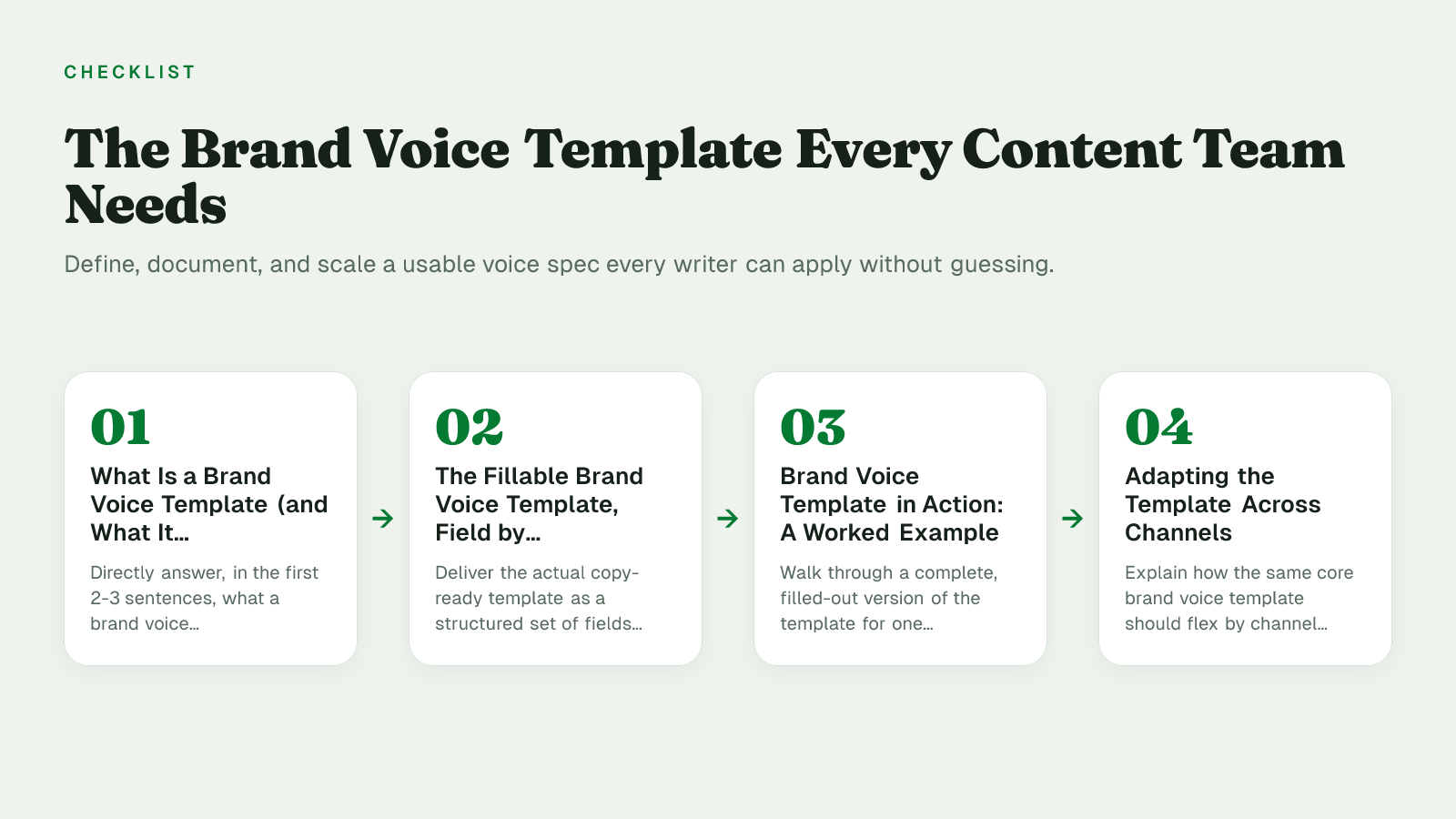
A brand voice template is a documented standard, filled out field by field, that defines personality adjectives with is/is-not definitions, do's and don'ts, tone-by-context rules, vocabulary guidance, grammar and mechanics rules, and example sentence pairs, so every writer produces the same voice instead of inventing a new one each time. Filled in correctly, it reads less like a mood board and more like a spec sheet writers can apply without guessing.
Without it, briefs default to vague adjectives like 'friendly' or 'professional' that mean different things to different people. The template removes that ambiguity by spelling out what each trait means in practice.
Personality traits anchor the voice. Do's and don'ts make it enforceable. Tone-by-context rules show how the same voice flexes when you're explaining, persuading, or apologizing. Vocabulary guidance locks in preferred words and phrases to avoid, and grammar/mechanics rules settle punctuation, capitalization, and formality. Example sentences are the proof: they let writers hear the difference between on-brand and off-brand.
Mailchimp published its Content Style Guide to make voice teachable, and a brand voice template does the same job for any team: it is a fillable document that locks personality into defined adjectives with is/is-not rules, audience, do's and don'ts, vocabulary, grammar mechanics, and example sentence pairs. Use the seven fields below as your copy-ready structure. For each adjective, write what it means in practice and what it does not mean, so any writer can apply it without guessing.
Verify current details directly in the primary sources themselves rather than relying on summaries: Mailchimp's public Voice and Tone guide, HubSpot's brand voice template post, and Nielsen Norman Group's four-dimension tone scale article referenced by HubSpot.
The table below pulls from those two public guides as sourced examples of how each field gets filled in, not an exhaustive survey of every brand's approach:
| Template Field | What It Captures | How HubSpot Frames It | How Mailchimp Frames It |
|---|---|---|---|
| Personality Adjectives (Is / Is Not) | Core traits driving word choice and attitude | 3-5 adjectives: clear, helpful, human, kind | Plainspoken, genuine, translator, dry humor |
| Mission-Linked Tone Statement | Why the voice exists and serves business goals | Favors clarity above all; mission-centered | Educate without patronizing; conversational partner |
| Audience Description | Primary reader, context, preferred communication style | Buyer persona infused into the voice | Small business owners facing marketing jargon |
| Do's and Don'ts | Concrete behaviors to repeat or avoid | Do be human, helpful; don't chase trends | Warm, active voice; no condescension or forced jokes |
| Vocabulary (Preferred vs. Banned) | Word bank keeping language consistent | Avoid hype and thesaurus hunting | Plain English; avoid jargon and upsell language |
| Grammar and Mechanics | Operational rules for sentences and formatting | Style rules per content type | Defines active voice, punctuation, formatting |
| Example Sentence Pairs | Same idea on-voice vs off-voice for calibration | Multiple examples per trait | Clear vs entertaining tradeoff; tone shifts |
A filled-out brand voice template for a freelance writer brief looks like a one-page profile: personality, vocabulary, and sentence rules filled in with usable copy rather than placeholder labels. Below is that profile for fictional B2B brand Summit Flow, a project-management tool for operations teams, shown exactly as a team would share it.
Fictional brand: Summit Flow – project tracking for ops teams who live in deadlines, not decks. Audience is operations managers at 50-200 person companies.
Personality: Calm, not anxious. Direct, not blunt. Expert, not academic.
Voice principles:
Vocabulary use / avoid:
Do / Don't:
Generic: "Our solution uses cutting-edge technology to streamline your workflows." Branded: "Summit Flow keeps your projects on track without adding extra meetings."
Generic: "We are excited to announce our innovative new feature." Branded: "You can now assign a clear owner to every task in one click."
Generic: "Please don't hesitate to reach out if you have any questions." Branded: "Stuck? Send us the project link and we will fix the setup."
Generic: "Our platform provides holistic visibility across the organization." Branded: "See what is late, who owns it, and what needs to happen next."
A brand voice template only works if the do's and don'ts are specific enough to flag a generic sentence before it publishes.
A single template rarely works unchanged across every channel a brand publishes on. The common mistake is treating it as one script that must sound identical on the blog, social, support docs, and paid ads. The fix is locking personality traits and hard do's/don'ts in place, then adjusting only four dials by channel: formality level, sentence length, humor, and CTA directness.

For blog and long-form, keep formality at your baseline and allow more explanation; humor works as illustration, not headline. Social shortens to one idea per sentence, drops formality by one notch, and permits more humor and timely reference. Customer support and help docs raise formality, cut sentences, remove humor except for light acknowledgement, and make CTAs explicit next steps. Paid ad copy keeps personality but compresses to verb-led lines and pushes the CTA to the front.
Document this as a one-page addendum pinned to the main template, not a separate guide. One table, same adjectives, different dial settings, so writers see what is non-negotiable and what flexes.
Use this checklist to build the addendum:
Once the template is adapted per channel, the remaining risk is losing consistency at scale as more writers, freelancers, and drafting tools start producing in parallel. That takes systems, not one-off edits.
HarperFlow publishes highly structured articles featuring FAQs, data tables, and direct-answer blocks that meet the rigorous citation standards required by AI search engines. By continuously auditing and improving your content through AI answer analytics, HarperFlow helps your site build long-term authority and visibility that outlasts ad-dependent strategies.
Rollout starts with training that forces exposure. Have every new writer review a batch of approved pieces that already pass the voice standard, then run a 30-minute walkthrough where you read aloud good and bad examples and explain why each fails. Give one paid test assignment with line-level voice feedback before anyone touches the live site, and keep the template in the same doc as the content brief so no one has to hunt for it.
Make voice checks part of publishing, not an afterthought. Build a three-step gate that runs before any draft ships: writer self-check against is/is-not definitions and banned phrases, peer or editor check that flags tone drift with a specific example, and a monthly audit where a single owner scores a sample of live pieces against the template and shares corrections in a shared log.
What breaks down is volume without ownership. Multiple agencies default to their house style, freelancers optimize for speed, and AI-assisted drafting reverts to generic language unless a profile constrains it. HarperFlow stores a brand voice profile and applies it automatically across every generated article, which helps teams that are scaling output but does not replace training and review.
Next step this week: assign one owner, pick a handful of live pages to audit against the template, run the training walkthrough, and lock the checklist into your publishing workflow.
HubSpot recommends 3-5 core characteristics to keep guidance memorable and enforceable. Fewer creates vague coverage and more creates conflicts writers cannot apply. Define each with an is sentence and an is-not guardrail, like HubSpot's clear, helpful, human, and kind.
Voice is stable, tone flexes by context. Mailchimp states it directly: "You have the same voice all the time, but your tone changes." Lock voice in your template, then document how tone shifts when you explain, persuade, or apologize.
Keep one voice but expand the audience field to cover primary and secondary readers, what each values, and how they prefer to be addressed. If word choices conflict, add audience-specific vocabulary swaps rather than forking the whole system. That way writers work from a single standard with notes on when to switch terms.
Write them as testable actions, not values. Do name the specific next step the reader should take, do not open with product features or adjectives about the product. Mailchimp models this by defining its voice as plainspoken, genuine, translator, and dry humor, which turns into concrete checks.
Yes, with a channel addendum. Keep personality adjectives and non-negotiable do's and don'ts locked, then adjust only four dials per channel: formality level, target sentence length, humor allowance, and CTA directness. For support, raise formality, shorten sentences, and require numbered next steps instead of soft closes.
List jargon your team actually overuses and pair each with an approved replacement that names outcome or ownership. For example, replace synergy and cutting-edge with on track, clear owner, and next step. Refresh the list monthly from your edit log so it stays grounded in real errors.
Have them review approved pieces, join a 30-minute read-aloud of good and bad examples with reasons, then complete one paid test piece with line-level voice feedback. Keep the template pasted inside the brief itself so they never have to hunt for it.
Use a three-step gate: writer self-check against is/is-not and banned phrases, peer or editor check that quotes the drift, and a monthly owner who scores a sample of live pages and logs fixes. The shared log becomes training material and keeps definitions from drifting.