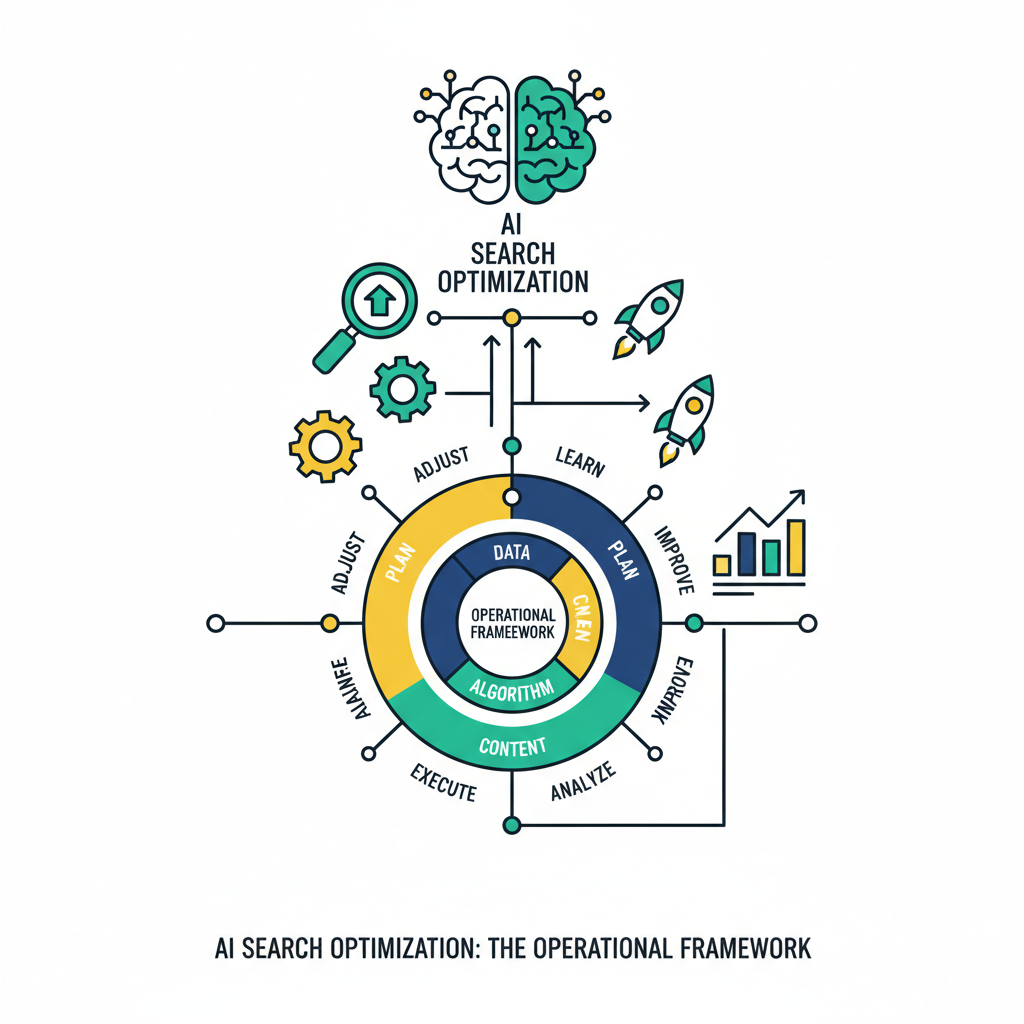
AI search optimization is the practice of structuring your website content and brand signals so AI answer engines like Google AI Overviews and AI Mode, ChatGPT, Perplexity, and Claude can find, synthesize, and cite it. Traditional SEO was built to rank your page in a list of blue links to earn a click; AI search optimization, also called generative engine optimization (GEO) or answer engine optimization (AEO), is built to become the source those systems quote when they answer. The biggest mechanical difference is straightforward: classic search sends users to a ranked list, while AI engines extract and cite passages directly inside the answer.
That changes what visibility means. In blue-link search, ranking on page one can still drive traffic even if the user never reads your page in depth. In AI search, you only get surfaced if the model's retrieval and synthesis step selects your content as reliable enough to include. Engines look for clear definitions, verifiable statements, and consistent brand and entity signals across the web, rather than keywords alone on a page.
Google's recent guidance frames optimizing for generative AI features as optimizing for the search experience itself, which makes AI search optimization a shift in method rather than a separate discipline. On-site, it means writing in a way that can be lifted cleanly as an answer. Off-site, it means making sure third-party sources confirm who you are and what you do, so models treat you as a trustworthy reference. If your content cannot be parsed as an answer, or your entity cannot be verified elsewhere, it is less likely to be cited.
What actually makes content extractable and citable comes down to structural techniques on the page.
AI answers are assembled by retrieval. Google describes its generative features as using Retrieval-augmented generation (RAG) to retrieve relevant, up-to-date pages and generate a grounded response. Models do not read your blog as a narrative; they pull self-contained passages that can stand alone as a citation.
Put the bottom-line-up-front. Search Engine Land's AI SEO guidance recommends implementing clear, standalone answer blocks at the beginning of content sections so AI systems can recognize and extract the core fact without parsing dense prose.
Follow that with a definition-data-context pattern: define the term plainly in one sentence, add the supporting data or specific example, then provide the broader context or trade-off. This structure mirrors how generative engines build answers: a concise claim plus evidence in the same chunk.
Use the same logic for headings. Google advises organizing content in a way that helps your readers with paragraphs and sections along with headings that provide a clear structure to navigate. That human readability directly improves machine extractability.
Generative systems prioritize sources that add something new. Google explicitly contrasts commodity content like "7 Tips for First-Time Homebuyers" with non-commodity content like "Why We Waived the Inspection & Saved Money: A Look Inside the Sewer Line" that provides a unique expert take based on first-hand experience.
That distinction maps to helpful, reliable, people-first content and its E-E-A-T framing. Search Engine Land notes Google's E-E-A-T guidelines heavily favor original, expert content with clear credibility signals, such as case studies, original research, and documented processes.
In practice, replace generic roundups with depth: proprietary data, client outcomes, screenshots of the actual implementation, or a specific mistake you observed and fixed. If an LLM could generate the same paragraph from common knowledge, it has no reason to cite you.
AI prefers structure that preserves meaning when lifted. Use:
Search Engine Land recommends creating information-rich tables, lists, and comparison sections that present data in easily digestible formats for both users and search engines. Keep each block self-contained so the answer, the supporting fact, and the source context travel together.
None of this earns a citation if the crawler can't reach the page in the first place, and that's a matter of technical access.
Structured content only earns citations if AI crawlers can actually reach it, which makes technical access a prerequisite, not an optional add-on.
Your robots.txt is the gate. It lives at yourdomain.com/robots.txt and every major AI crawler honors it by user-agent token. The most common failure is a lingering wildcard Disallow: / under User-agent: * that silently catches bots you never explicitly allowed.
To be citable, audit for distinct AI crawlers including GPTBot, OAI-SearchBot and PerplexityBot:
GPTBot for training, OAI-SearchBot for search indexing eligibility, ChatGPT-User for live user-triggered fetchClaudeBot, Claude-SearchBot, Claude-User, each token is independent and needs its own directivePerplexityBot for retrieval that powers cited answers, Perplexity-User for on-request fetchGoogle-Extended controls use for Gemini training and does not affect Google Search ranking via GooglebotCCBot (Common Crawl, often reused as training data) and Bingbot (Microsoft index used by many AI answers as a retrieval fallback)Best practice is to list agents individually with Allow: / for the paths you want cited, rather than relying on a single wildcard. That lets you separate training from search visibility. For example, allow OAI-SearchBot and PerplexityBot while disallowing GPTBot if you don't want training use.
The llms.txt convention is a lightweight complement to robots.txt and sitemap.xml. It is a Markdown file placed at the site root at /llms.txt that gives LLMs a curated, unambiguous entry point instead of forcing them to parse heavy HTML, navigation, and ads.
Per the spec, the file starts with an H1 containing the site or project name as the only required section, optionally followed by a blockquote summary and freeform paragraphs, then one or more H2-delimited file lists. Each list item is a Markdown link [title](url) with an optional description. An Optional H2 signals secondary material that can be skipped when context is short. Some sites also publish .md versions of key pages at the same URL path with .md appended for clean LLM ingestion.
Heavy client-side JavaScript is a silent blocker. Many AI fetchers retrieve the initial HTML without executing the full JS bundle, so content that only appears after hydration is invisible at citation time. If your blog renders titles, body copy, or key facts via client-side frameworks, move to server-side rendering or static pre-rendering for content pages and verify what an AI sees by viewing the raw response body, not just the painted DOM.
Blocking AI crawlers via robots.txt to 'protect' content is usually counterproductive: it removes you from the exact answers you're trying to be cited in.
Getting AI engines in the door is only half the job. Entity and citation signals determine whether they trust what they find once they're there.
Being crawlable is necessary but not sufficient: AI engines also need to recognize your brand as a distinct, trustworthy entity before they'll cite it.
LLMs cannot cite what they cannot disambiguate. Google's own documentation shows LocalBusiness structured data defined at schema.org/LocalBusiness as a supported type for rich results, alongside other types in the same gallery. Industry guides note common supported types remain Article, Product, Event, LocalBusiness, FAQPage, HowTo, and Organization.
For AI search optimization, the priority set is narrow:
@id. This is the anchor for every other signal.What connects them is sameAs. The sameAs property in your Organization schema lets you explicitly link your brand to its Wikipedia page, LinkedIn company page, Crunchbase profile, and other authoritative sources, giving crawlers a deterministic ID to resolve which "Frase" or "Atlas" you are.
AI models triangulate identity against sources they trust more than your website. Brands enter the Knowledge Graph through Schema.org markup, Wikidata entries, sameAs equity across authoritative profiles (LinkedIn, Crunchbase, GitHub, industry directories), and consistent third-party mentions.
Practical checklist:
@id for Organization across all templates so every page asserts the same entity.Training data and live retrieval both weight independent mentions. Digital PR in trade press, founder quotes in industry roundups, and substantive discussion on Reddit or Quora where real users reference your product by name all become corroboration signals. One press mention does not move the model; a pattern of consistent descriptions across independent sources does.
Treat community mentions as citation hygiene, not link building: answer questions with definitional language that matches your on-site opener, avoid promotional filler, and let third parties describe the entity in their own words.
| Optimization Vector | Traditional SEO | AI Search Optimization (GEO) |
|---|---|---|
| Primary target | Keyword rankings and backlink authority for pages | Entity recognition and trust for brands, products, and people |
| Content goal | Earn a position in a ranked list | Earn inclusion as a cited source inside a generated answer |
| Format preference | Keyword-optimized pages with on-page factors | Passage-level definitions with structured data linking to stable IDs |
| Freshness cadence | Episodic refresh tied to ranking drops | Continuous refresh because recency is a corroboration signal |
| Citation mechanics | Backlinks as votes that transfer equity | Triangulated mentions across sameAs profiles, press, and community discussion |
Structure, access, and entity trust only compound if they're measured and repeated, which is where most teams stop short.
AI citations drift constantly, so you have to measure them like a product metric, not a one-time checklist. Start with a repeatable chatbot audit: build a fixed pack of 15-20 prompts that match how buyers actually ask (commercial (best X), comparison (X vs Y), problem-solving (how to…), and definition (what is…)) then run the identical set across ChatGPT, Perplexity, Gemini and Google AI Mode / AI Overviews and log for each whether you are cited with a link, mentioned without one, or absent, plus which domains and URLs are cited instead.
That log surfaces why competitors win. If they own comparison queries, they likely have deeper comparison pages or stronger third-party validation; if you are mentioned but not linked, your passage was useful for synthesis but not trusted enough to cite. Frase's GEO playbook frames this as monitoring your brand's appearance across ChatGPT, Perplexity, Claude, Gemini, and Google AI daily (tracking share of voice, citation sentiment, and the specific gaps where competitors are winning) so you prioritize prompts where competitors are cited and you are not rather than rewriting everything.
Turn the audit into KPIs you track over time. Teams doing this at scale automate collection: Otterly.AI tracks all links weekly and monitors link position changes over time, letting you track citation frequency (how many prompts cite you), appearance rate (percent of prompts with any citation), share of voice versus your top three competitors, and which of your pages earns citations, broken out by engine.
Set a cadence because AI answers are not stable. Between 40-60% of cited sources change from month to month as models and indexes update, so single-pass optimization fades. Weekly, scan for large citation swings and new competitor wins; monthly, review share-of-voice trends and top cited pages; quarterly, reset your prompt pack to reflect shifts in buyer language and product areas. When a gap persists, test one variable at a time (adding first-party data, improving passage-level clarity, or earning mentions on sources weighted heavily by one engine) then rerun the same audit to see if citation rate moves. The full loop (structure, access, entities, and measurement) clarifies what's worth doing manually versus what's worth automating.
The practical question, once the framework is in view, is what to fix once and what to keep doing.
The one-time layer is access and identity. That includes allowing the right AI crawlers in robots.txt, publishing llms.txt, setting up your structured data templates in Webflow, and aligning your canonical business profiles. Once implemented correctly, these need only guardrails and periodic spot-checks to stay accurate.
The continuous layer is publishing behavior. Writing with direct answers up front, backing claims with outside sources, keeping high-value pages fresh when the underlying facts change, and checking whether engines still surface you are habits. That work compounds when repeated. It decays when stopped.
Use three practical filters:
If you can answer yes and name an owner, manual execution works. If not, the failure mode is predictable: a strong start followed by stale content that loses citation share.
For Webflow teams in the second camp, HarperFlow is one way to run the ongoing publishing part of this framework without building the workflow yourself. It automates the research, answer-first structuring, sourcing with external citations per article, and direct publishing to Webflow, while your team retains ownership of the one-time technical and entity setup described earlier.
Treat AI search optimization as a publishing rhythm, not a one-time audit: the sites getting cited repeatedly are the ones still producing sourced, structured content months later.
Pick a rhythm you can hold for six months, instrument who owns each part of the loop, and only add volume after the loop is stable. That is how citation presence turns from a spike into durable demand.
Yes. OAI-SearchBot handles search indexing eligibility for AI answers, while GPTBot is for training. You can Allow OAI-SearchBot and Disallow GPTBot in robots.txt to stay citable without allowing training use.
Each Claude token is independent and needs its own directive. Blocking only ClaudeBot does not block Claude-SearchBot or Claude-User, so you must write separate Allow or Disallow lines for each in your robots.txt.
No. Google-Extended controls use for Gemini training and does not affect Google Search ranking via Googlebot. AI Overviews and AI Mode rely on standard indexing via RAG, so you can manage training permission separately.
It is not required but works as a complement to robots.txt and sitemap.xml. Publish a Markdown file at /llms.txt at the site root, starting with an H1 site name as the only required section, then H2 file lists using title links with optional descriptions.
Often not reliably. Many AI fetchers read the initial HTML without executing the full JS bundle, so content that only appears after hydration is invisible at citation time. Move article body, definitions and facts to server-side rendering or static pre-rendering and verify the raw response.
Start with a fixed pack of 15-20 prompts covering commercial, comparison, problem-solving and definition intents. Run the identical set across ChatGPT, Perplexity, Claude, Gemini and Google AI and log whether you are cited with a link, mentioned without one, or absent.
Between 40-60% of cited sources change from month to month, so a one-time audit decays fast. Teams monitor appearance daily across ChatGPT, Perplexity, Claude, Gemini and Google AI and track link position weekly, then review share of voice monthly and reset the prompt pack quarterly.
Only when the page is genuinely Q&A-shaped. Common types that remain useful for machine readability are Article, Product, Event, LocalBusiness, FAQPage, HowTo and Organization, with Organization plus sameAs linking as the higher-impact anchor for AI disambiguation.