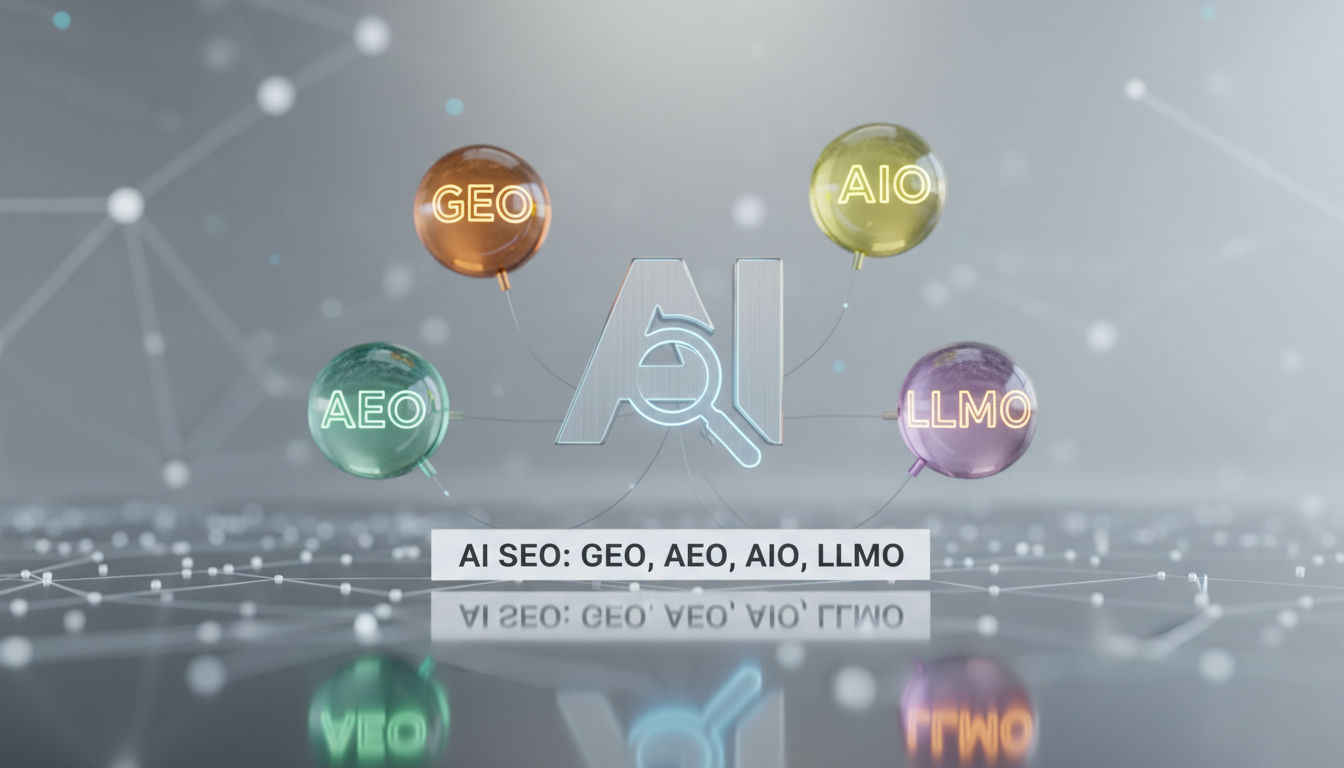
SEO for AI does not have one official name. The term most teams use today is Generative Engine Optimization (GEO), with Answer Engine Optimization (AEO), AI Optimization (AIO), and Large Language Model Optimization (LLMO) as overlapping variants used to describe the same underlying work: earning citations in ChatGPT, Perplexity, and Google's AI-generated answers.
You feel the naming problem when you need to label the work in a proposal or a client asks what to call ranking in ChatGPT and Google's AI-generated results. Everyone means getting cited in AI answers, but different corners of the industry coined names at the same time.
The language is still settling because the discipline is new, and multiple surfaces (chat assistants, AI-generated summary panels, and standalone systems built to answer questions directly) all broke out around 2023-2024 with separate communities writing playbooks. GEO has become the de facto umbrella because it directly describes optimizing for generative engines, while the others started as more specialized labels that now largely describe the same work. With the headline answer set, the useful step is to unpack what each acronym actually points to.
GEO was formalized in the academic paper GEO: Generative Engine Optimization by Aggarwal et al., first submitted on 16 Nov 2023 and accepted to KDD 2024. All five terms describe how to earn visibility, but they were introduced for different search surfaces and measure success by different signals, which raises an obvious follow-up: what distinguishes these acronyms from each other, and are they really separate disciplines?
GEO, Generative Engine Optimization, comes from that Princeton-originated research. The paper frames generative engines as systems that combine information from multiple sources and summarize it using LLMs, and defines GEO as a framework to improve content visibility in generative responses. In its evaluation, the authors report GEO can boost visibility by up to 40% in generative engine responses. In industry use today, GEO targets generative surfaces like ChatGPT, Claude, Perplexity, and Google's AI-generated overview panels, with a focus on being cited and quoted as a source.
For AEO, Answer Engine Optimization, independent industry explainers describe the practice of structuring content so AI-powered search engines select it as the direct answer to a query. It sits under the broader AI-optimization umbrella and focuses on winning direct-answer placements: snippet-style summaries, People Also Ask, voice results, and the answer box layer inside AI search. The core focus is answer extraction and attribution, not just ranking.
AIO, AI Optimization, is used as the broadest catch-all. The same industry taxonomy defines it as the AI-era equivalent of SEO, covering all optimization aimed at AI systems including Gemini, ChatGPT, or Claude. Its focus is machine readability and semantic understanding across models.
Narrower still is LLMO, Large Language Model Optimization, typically defined as applying natural language processing techniques to influence how LLMs understand and reflect content. The target is the LLM itself, and success is judged by how accurately and favorably the model represents your content, brand, or facts.
Traditional SEO, Search Engine Optimization, remains anchored to classic web search. Its target surface is the indexed web and the list of blue links. Its focus is crawlability, relevance matching, rankings, and clicks, supported by technical foundations like internal linking and site speed.
| Term | Full Name | Primary Target Surface | Optimization Focus | Typical Tactics |
|---|---|---|---|---|
| GEO | Generative Engine Optimization | Synthesizing generative engines: ChatGPT, Perplexity, AI-generated overviews | Citation and quotation visibility (up to 40% boost) | Quotable definitions, sourced statistics, structured data, authoritative coverage |
| AEO | Answer Engine Optimization | Answer engines: snippet-style summaries, People Also Ask, voice, AI answer boxes | Direct-answer extraction; selection as the definitive answer | Q&A format, upfront answers, clear headings, FAQ schema |
| AIO | AI Optimization (broadest umbrella term) | All AI systems: Gemini, ChatGPT, Claude, AI search | Machine interpretability and AI readability | Structured content, topic coverage, semantic clarity |
| LLMO | Large Language Model Optimization | Large language models themselves: ChatGPT, Claude, Gemini | How LLMs understand and represent content | NLP-oriented phrasing, consistent entity mentions, knowledge-graph signals |
| Traditional SEO | Search Engine Optimization | Traditional web search: Google and Bing blue links | Relevance, ranking, and click-through | Technical SEO, internal linking, site speed, backlinks |
GEO has become the de facto umbrella term in industry usage even though AEO, AIO, and LLMO describe real, slightly different sub-focuses. Pick the term based on audience, not because the tactics fundamentally conflict.
Search Engine Land published a September 2026 guide stating GEO, AEO, AIO and LLMO mean essentially the same thing, and HubSpot reinforces that overlap in its own comparison of the terms. All four describe the same underlying work of earning citations in AI answers, sharing most tactical execution across engines rather than requiring separate programs.
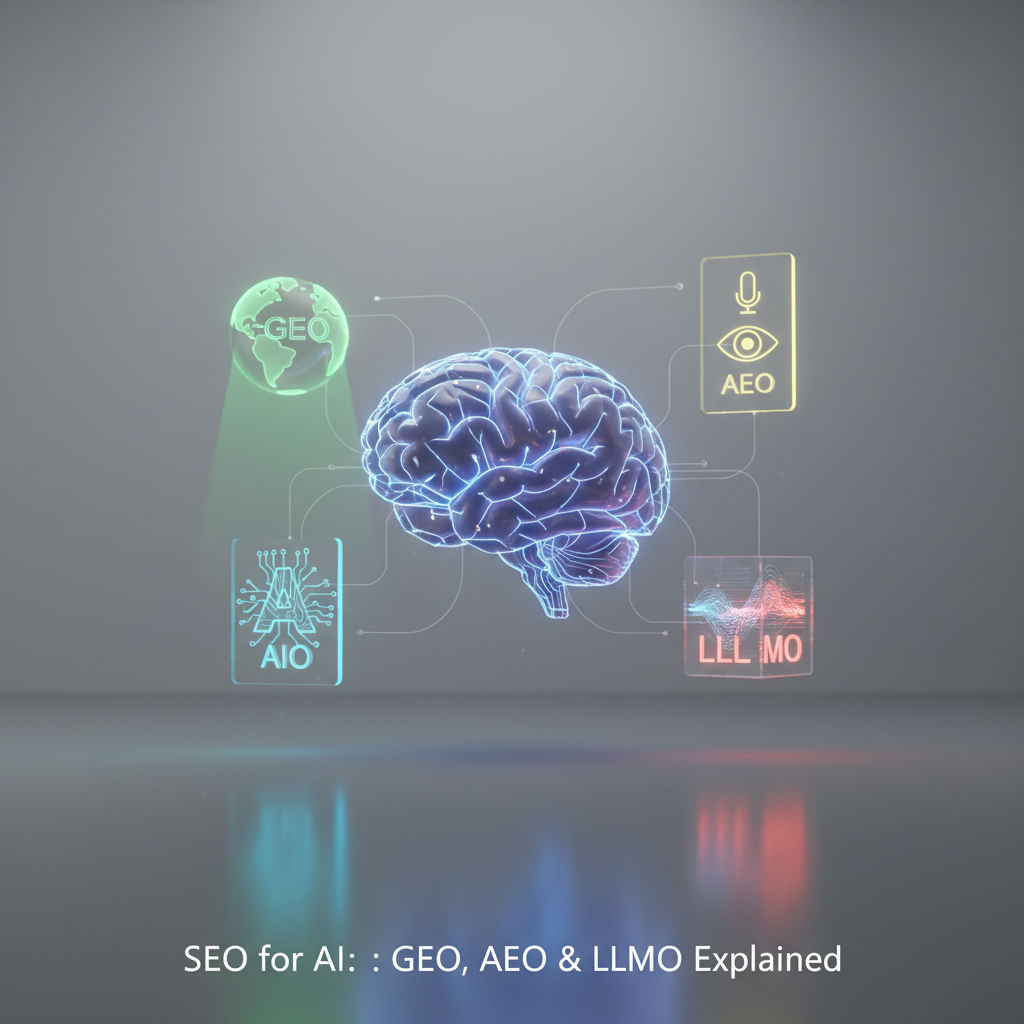
Mapped side by side, the four terms clearly target different surfaces on paper, but in day-to-day practice, the lines blur. A page built with clear headings, direct answer-first formatting, authoritative third-party sourcing, schema that defines entities, and self-contained quotable passages serves ChatGPT, Perplexity, Google's AI-generated overviews, and voice assistants at once. The signals these systems reward (relevance, clarity, and verifiable authority) do not change because the acronym does.
That overlap is why the label choice is best treated as audience shorthand, not a separate strategy. Use GEO when the conversation is about generative chat assistants like ChatGPT, Perplexity and Gemini, where earning citations in synthesized answers is the goal. Use AEO when the stakeholder is focused on answer surfaces like snippet-style summaries, People Also Ask, voice results, or AI-generated overview panels. Teams that need extra precision often say AIO for Google's AI-generated overview panels specifically, and LLMO when discussing the technical retrieval layer underneath. As HubSpot notes, the practical difference is mostly terminological: some teams reserve AEO for snippet-style summaries and People Also Ask and use GEO for generative outputs, while others use AEO as the umbrella. You are naming the same work through the lens your client already understands.
Practitioners also say "AI SEO" and "Generative SEO" informally. Those labels map onto the same concept that Search Engine Land describes as AI SEO building on traditional SEO by expanding visibility to being retrieved, cited and recommended by AI systems. They are plain-language shorthand for applying familiar foundations to engines that synthesize rather than just rank.
Understanding that the terms converge in practice sets up the real question: what should a team actually change about how it produces content?
Showing up in AI answers comes down to one habit: put a direct, self-contained answer at the very top of each section, then back it with dated third-party sources and machine-readable structure.
HarperFlow publishes highly structured articles featuring FAQs, data tables, and direct-answer blocks that meet the rigorous citation standards required by AI search engines. By continuously auditing and improving your content through AI answer analytics, HarperFlow helps your site build long-term authority and visibility that outlasts ad-dependent strategies.
Content teams adapting for this work make four consistent shifts:
Answer first, then explain. Each page, section, and FAQ should open with a concise summary that can stand alone. AI-ready FAQ guidance recommends treating every Q&A as a self-contained content unit that makes complete sense when pulled in isolation, starting with a one-sentence summary before elaborating.
Ground claims in verifiable sources. Instead of asserting facts from memory, link to the primary publication, report, or dataset with its publication date visible on the page. That habit signals authority to readers and to retrieval systems that favor cited, fresh evidence.
Use structure that machines can extract. Clear H2 and H3 headings phrased as natural questions, short paragraphs, bullet lists for steps, comparison tables, and visible FAQ sections make your content easy to parse. Avoid embedding key facts only in images, and keep answers independent rather than referring to "as mentioned above."
Publish for topical coverage, not one-offs. Build clusters of interlinked articles that answer related questions around a core topic, update pages when sources change, and link between them with descriptive anchors. Consistency builds the entity signals that influence citation more than a single post.
To check whether it is working, run the same set of audience questions regularly across Google's AI-generated overview panels, ChatGPT with browsing, and Perplexity. Note whether your brand or URL appears, which page is cited, and which competitors show up instead. Manual query testing logged in a simple sheet (date, platform, query, cited URL, position) creates a baseline without a paid tool and shows where to tighten answers, sources, or structure next.
Treating the label as the outcome is the real mistake teams make with GEO terminology. AI citation comes from publishing cadence, not from choosing GEO over AEO or AIO.
With the definitions, the overlap, and the practical shifts covered, the last piece is how teams actually sustain this work. Most teams can research one article well, add named sources, structure it for quotability, and ship it to Webflow. Repeating that every week for a quarter is where it breaks: topic selection gets reactive, sourcing thins out, formatting drifts, and the publish slot gets skipped.
That consistency is what earns trust. A site that repeatedly publishes structured, well-sourced answers on a tight topic builds a track record engines can lean on. One perfect post does not.
So pick the term your stakeholders already understand (GEO is now the most common shorthand), set a simple standard for what "done" means, and protect the time to ship. For teams where manual research, sourcing, and formatting becomes the bottleneck, automation is one practical path: HarperFlow automates the research-to-publish pipeline for citation-ready articles, from opportunity finding to styled publishing in Webflow.
Stop debating acronyms. Commit to a weekly habit of sourced, structured publishing and make citation inevitable.
Use GEO as the default because it is the most widely recognized umbrella term today. If your stakeholder cares about featured snippets and People Also Ask, frame it as AEO; if they think in terms of model behavior, LLMO makes sense. The tactics stay the same, so match the label to their vocabulary.
Yes. Traditional SEO ensures your pages are crawlable, indexed, and trusted, which is the prerequisite for being retrieved and cited. Generative engines still rely on that foundation and then add citation and synthesis.
You do not need separate programs. Clear headings phrased as questions, direct answers up front, and sourced facts serve all three surfaces because they reward the same signals of clarity and verifiable authority.
Run a manual baseline described by citation tracking guidance: query ChatGPT, Perplexity and Google with your top 10-20 audience questions and log whether your brand, URL and competitors appear. Repeat weekly from a simple sheet.
Treat every question and answer as a self-contained unit that makes complete sense when pulled in isolation, with no "as mentioned above" dependencies. Start with a one-sentence summary before elaborating, so the answer can be extracted directly.
No, the formats reinforce each other. A well-structured page with quotable definitions and answer-first formatting can rank in classic results and also be selected as the direct answer, because both systems favor relevance and clarity.
Citations favor freshness, consistent topical coverage, and clear entity signals over a single post. Update publication dates when sources change, interlink related articles, and keep your definitions and statistics linked to primary sources.
Adapt existing content first. Add answer-first summaries to each H2 and H3, convert key facts out of images into text, and insert self-contained FAQ blocks where questions naturally arise, rather than creating thin separate pages.