The article explains why publishing more blog posts often harms SEO, detailing the content-mill trap. It dissects four mechanisms—keyword cannibalization, crawl budget waste, link equity dilution, and weak user signals—and adds a second penalty: AI answer engines skipping uncitable pages. It then provides an audit and consolidation framework and a depth-first editorial workflow to rebuild authority.
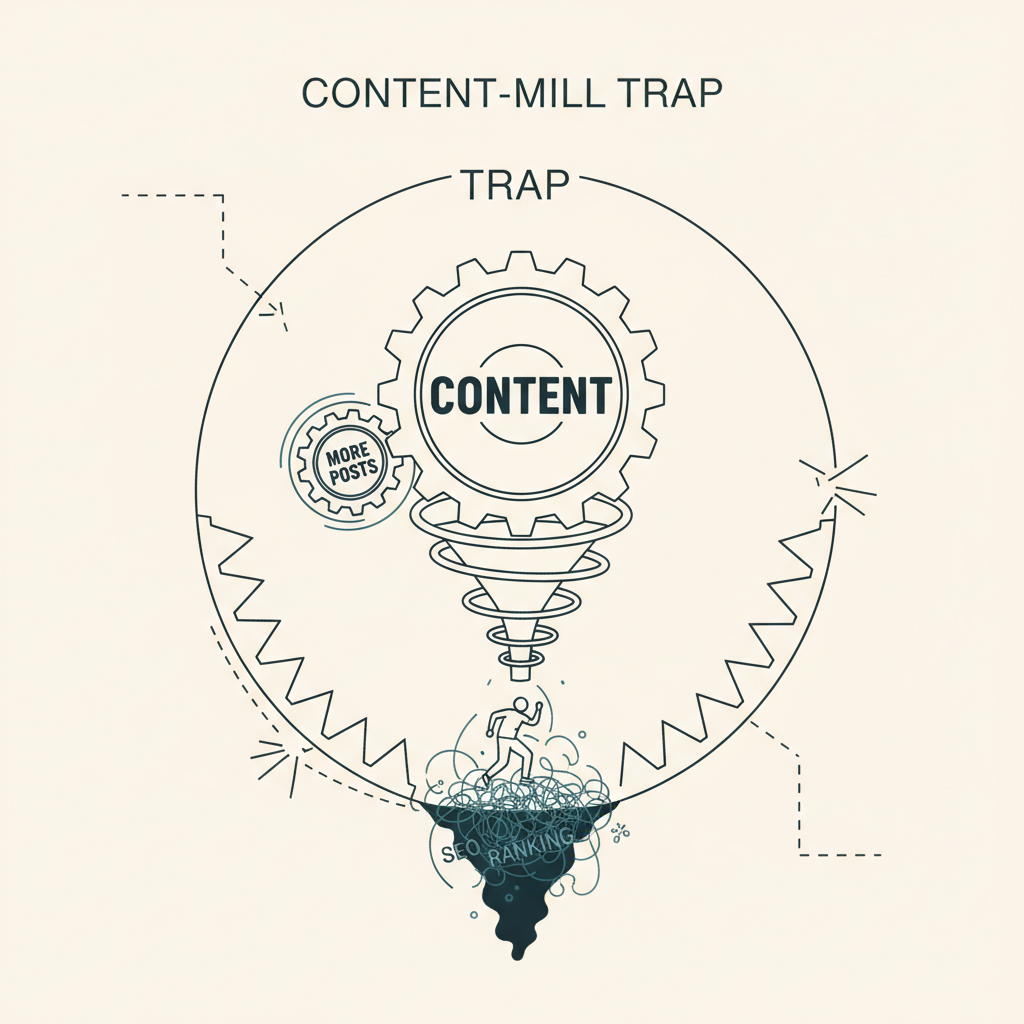
Publishing more blog posts kills SEO when volume outpaces evidence and depth. Each shallow, overlapping post wastes crawl budget, competes with your own pages through keyword cannibalization, dilutes link equity, and triggers thin-content quality signals, while also making pages unfit for citation by AI answer engines like Google AI Overviews and Perplexity.
The pattern has a name: the content-mill trap — many posts, shallow research, repetitive angles, optimized for calendar cadence instead of information gain.
In that trap, publishing itself becomes the penalty. Search crawlers must sort through hundreds of under-optimized pages that spread internal links thin and force your best pages to fight your weakest for the same intent, while quality systems read low-depth repetition as a site-wide signal to trust less. Recent analyses of scaling failures note exactly this combination of crawl budgets stretched thin across hundreds of underoptimized pages and cannibalization quietly undermining rankings.
The result is flat traffic at best. You keep shipping, but rankings compress, conversions per post drop, and answer engines skip you because there is nothing traceable to quote. That's the headline mechanism — what follows unpacks exactly how each classic SEO penalty fires when volume outpaces substance.
Ranking is one battle; being cited by an AI engine is another. Before getting to what changes in that second battle, it helps to isolate how four familiar mechanisms actively hurt the pages you already own.
Search Engine Land describes keyword cannibalization as occurring when two or more pages from the same domain target the same or similar keywords and search intent, which causes the pages to compete with each other in rankings. The causal chain is straightforward: overlapping intent forces the engine to choose, but it has no clear signal of which URL is authoritative. The result, as the same guide notes, is splitting ranking power across URLs, fluctuating positions, and sometimes surfacing the wrong page for the query. That confusion lowers CTR and fragments the engagement signals that would otherwise consolidate around one strong page.
For teams asking what happens on the technical side, Oncrawl frames this as crawl waste versus efficient budget: every site gets limited crawl attention, and waste happens when bots spend it on pages that should not be crawled, or should be crawled much less frequently. Common waste types Oncrawl lists include duplicate pages with malformed URLs, pages created automatically but not used, pages with parameters or query strings, and static low-value pages. When a content mill pushes dozens of thin posts, these buckets grow. New and updated money pages wait longer to be recrawled, so fixes and internal link improvements take longer to be recognized.
For the pages that do earn attention, inbound links are still a primary authority signal. Search Engine Land points out that when multiple pages focus on the same keyword, you risk people linking to several different pages, diluting the power of what could have been an authoritative page with a strong backlink profile. One excellent, well-sourced guide that earns ten solid references will outrank five mediocre posts that each earn two, even if total link count is the same, because authority is not additive across competing URLs.
Underneath both problems sits a behavioral one. When searchers land on the wrong cannibalized result or a thin post that restates what stronger pages already cover, they leave quickly. Search Engine Land connects this directly to cannibalization outcomes, noting high bounce rate indicates content is not meeting needs, and low CTR when the wrong intent match is surfaced. Those behavioral patterns (short dwell, pogo-sticking back to results, low repeat engagement) become secondary quality filters that reinforce the decision to demote both the thin page and the cluster around it.
Volume without evidence doesn't help rankings. It actively cannibalizes the pages you already have.
Those are legacy-SEO consequences. A second, newer penalty compounds them, and it has nothing to do with rankings at all.
Google AI Overviews, AI Mode, Perplexity, ChatGPT, and Claude rank pages for clicks, but they also extract answers from pages they can quote cleanly without distorting meaning. A page can still rank and never get cited if its claims are buried, ambiguous, or impossible to attribute.
That changes what counts as "evidence." To a traditional blog, evidence might be a longer paragraph. To an answer engine, evidence is density and traceability: a named dataset with a date, a direct expert quote with title and publication, a number tied to a primary source one sentence away. Content-mill archives do the opposite; they paraphrase the same generic advice across dozens of posts, with no clear claim-to-source mapping. The model sees narrative, not extractable fact, and moves on.
Perplexity's described behavior makes this filtering visible. Reporting on its retrieval process describes a multi-stage pipeline that parses intent, does hybrid retrieval, then applies reranking layers including a quality gate before LLM synthesis with inline citation. In that flow it reportedly retrieves on the order of a handful of candidate pages per query and cites only a subset in the final answer, with a preference for sources updated recently. More than half of retrieved pages are cut because they fail relevance, freshness, entity clarity, or extractability checks. Google's systems use different models, but the same principle holds: they favor pages that answer first, name the entity exactly, and keep proof adjacent to the claim.
The measurable quality signals highlighted by the SourceBench evaluation framework (content relevance, factual accuracy, objectivity, freshness, authority, and clarity) are brutal for content-mill libraries. A thin post that talks around a topic fails relevance at retrieval. One that covers five topics fragments entity attribution and fails the quality gate. One that separates claims from proof forces the model to infer connections it will not make at synthesis. Recency bias compounds it: pages without current dates, updated stats, or timestamped structured data lose in reranking to fresher equivalents.
In practice, this is why volume without evidence compounds authority loss. You are publishing pages that don't help ranking, and answer engines learn to ignore them.
| Signal | Content-Mill Approach | Evidence-Based / Citation-Ready Approach |
|---|---|---|
| Evidence density | Generic summary without numbers, dates, or named entities | Specific fact with number, date, and named dataset placed next to the claim |
| Traceable sourcing | Unattributed paraphrase or 'experts say' | Direct expert quote with title, study name, and inline source link mapping 1:1 to claim |
| Structural extractability | Buried conclusion, long paragraphs, mixed topics | Direct answer in opener, one claim per section, clean H2/H3 hierarchy |
| Information gain & freshness | Repeats consensus from months ago with no update stamp | Adds original test, comparison table, or updated stat with visible last-updated date |
| AI answer-engine citation eligibility | No claim-to-source mapping; nothing an engine can quote without inferring connections | Each claim traceable to one named source, structured so an engine can lift and attribute it directly |
Once you understand both penalties, the fix is the same: audit what you have and change how new pieces get built.
Diagnosing both penalties is step one. Here's the operational sequence to fix an existing archive and change what gets published next.
Start with a full URL export from your crawler (Screaming Frog, Sitebulb) joined with performance data. Search Engine Land's pruning guide frames content pruning as a process where managers strategically review or audit content in large quantities and decide how to optimize it, and it points to the same core sources teams actually use: Google Search Console for organic traffic and keyword visibility, and Google Analytics for engagement and conversions.
In that sheet, pull for each blog post: clicks and impressions from GSC, sessions and engagement rate from GA4, conversions or assisted conversions, backlinks, publish date and last substantial update, and whether the URL has competing versions targeting the same query. To surface candidates fast, many teams apply a simple low-traffic filter as a first pass (reviewing any page whose clicks over a six-month window are negligible) then layer in context before acting.
Look for three patterns: zero to near-zero value (no clicks, no links, no internal use), mismatch (ranks but wrong intent, or used by Sales but not by Search), and overlap (two or more posts serving the same objective).
Use the same five options most documented audits converge on, including the Merge, Prune, or Refresh framework:
Before you delete anything, record baseline metrics: clicks, primary query, rank, backlinks, conversions, internal links in/out. That lets you measure lift and roll back if needed.
When you merge, choose one primary URL and rewrite rather than paste. Carry over unique examples, original quotes, and any ranking sections. Implement a 301 from each secondary URL to the primary, update all internal links to point directly to the live URL to avoid redirect chains, fix canonicals, and rebuild the cluster links to reinforce the hub. Coordinate with stakeholders (Sales, Support, Product) so you don't delete a page they still circulate.
For every keeper or new idea, require something competitors can't replicate without work: proprietary data, a customer analysis, an expert interview, teardown of a real implementation, or a distinct angle that changes the answer. If a draft can't meet that bar, it doesn't publish. Log target query, intent, objective, and expiration review date in your content database so you don't recreate the same post six months later.
Fixing the archive is necessary but not sufficient. The editorial workflow that produces new content has to change too.
Most teams exit the content-mill cycle by replacing a publishing quota with an evidence quota. Instead of asking "did we publish this week," ask "do we have something new to prove this week." That single shift changes how calendars, briefs, and approvals work.
In a landscape crowded with generic content, HarperFlow prioritizes transparency and quality with automated sourcing and citation. This builds trust with AI answer engines and your audience alike, helping your content compound authority and continue driving traffic over time.
1. Start with research before drafting. Before a writer opens a doc, the topic owner collects primary inputs: customer questions, product data, internal subject-matter input, and two to three external sources worth citing directly. If you cannot find original insight or traceable sources that support a fresh angle, the topic does not move forward.
2. Require traceable sourcing in the draft. Every non-obvious claim gets a named source and a link in the first draft, not as an afterthought. Keep links tight to the claim they support, use a consistent citation style, and avoid vague "studies show" phrasing. Readers and answer engines both trust specificity over volume.
3. Structure for extraction from the start. Build the post so a machine and a human can pull the answer without guessing:
This is where tooling helps. HarperFlow is one example of a workflow built specifically around this discipline (research before output, then drafting with traceable sources and formatting designed for answer extraction) without treating volume as the goal.
Put this checklist on your next brief and enforce it at review:
If you answer no to the first three or yes to the last, cut it or combine it into an existing piece.
If a new post can't add evidence an AI engine would want to quote, it shouldn't be published.
Look in Google Search Console for the same query triggering multiple URLs with similar impressions and fluctuating positions. Search Engine Land's definition says it occurs when two or more pages target the same intent and compete. If the wrong page gets the clicks or CTR drops, that cluster needs consolidation.
Not automatically. That is a mismatch pattern. If both serve distinct jobs, consolidate to the URL with the best clicks, backlinks, and internal support but preserve the converting elements and CTAs in the merged piece. Then point all internal links directly to the primary URL.
Avoid bulk deletion. Build a single inventory with clicks from GSC and engagement from GA4 as Search Engine Land's pruning guide recommends, then triage with Merge, Prune, or Refresh. Record baselines for each URL so you can measure lift and roll back safely.
Use noindex for pages useful to humans but harmful to search, like limited-audience sales pages or duplicate promos. Use a 301 when the page is irrelevant, inaccurate, and unused. Both approaches reduce crawl waste, which Oncrawl defines as pages that shouldn't be crawled, or should be crawled much less frequently.
Classic penalties are crawl waste and split ranking power across competing URLs. AI engines add a second penalty: they run a multi-stage pipeline with quality gates that drop sources lacking relevance, freshness, and clear extractability, so a thin post can still rank and never be cited.
Volume alone does not protect traffic when you have crawl budgets stretched thin across hundreds of underoptimized pages and cannibalization quietly undermining rankings. Teams that shift to an evidence quota usually see fewer URLs but higher clicks per post, more stable rankings, and better eligibility for AI citations.
Check link profiles before acting. Search Engine Land notes that having multiple pages focused on the same keyword dilutes what could be one strong backlink profile. Consolidate to the strongest URL and 301 the secondaries there to stack authority instead of scattering it.
Yes if the page already earns steady clicks or conversions and has no close duplicate. Refresh with specific facts, a named dataset with date, and a direct expert quote placed next to the claim to meet signals of relevance, factual accuracy, objectivity, freshness, authority, and clarity. If two posts still serve the same objective, merge rather than refresh separately.
HarperFlow publishes highly structured articles featuring FAQs, data tables, and direct-answer blocks that meet the rigorous citation standards required by AI search engines. By continuously auditing and improving your content through AI answer analytics, HarperFlow helps your site build long-term authority and visibility that outlasts ad-dependent strategies.
Start Your Trial TodayLover of all things automation and all things content.
Your privacy
Necessary storage keeps the site secure and working. With permission, analytics helps us improve it and marketing tools measure campaigns. Google can still send limited cookieless signals when optional storage is off. Read our Privacy Policy.
Your browser sends a privacy signal (Global Privacy Control), so optional technologies start off — your choice here takes precedence.
Privacy choices
Necessary storage supports security, consent, and the features you request. Optional categories can be changed at any time.
Security, fraud prevention, consent preferences, form delivery, and popup suppression.
Your browser sends a Global Privacy Control signal, so optional technologies start off by default. Your explicit choice here takes precedence.
A practical AEO/GEO manual for making your Webflow site clearer, better sourced, and easier for answer engines to use—without gimmicks or guarantees.
Find gaps in discovery, extraction, evidence, authority, and freshness
Use evidence patterns, briefs, and fill-in worksheets
Run a focused 30-day AEO/GEO operating sprint
We’ve emailed your copy. It should arrive within a few minutes.
If it is not in your inbox within a few minutes, check spam or promotions.