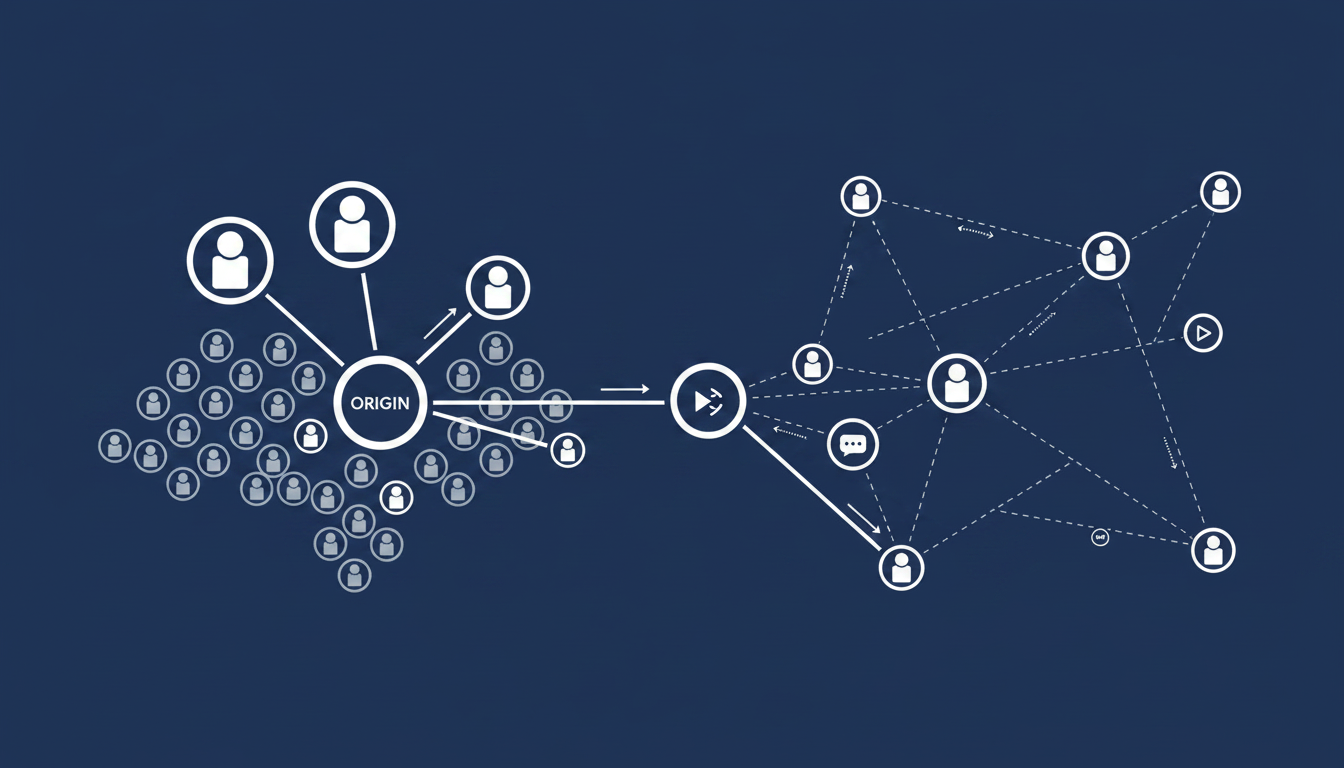
Content syndication is republishing an exact or adapted copy of your content on a third-party site, usually via agreement, while content distribution is the broader act of sharing that content across owned, earned, and paid channels to get it in front of the right audiences. Today that also means getting it in front of the AI answer engines increasingly standing between your work and its readers.
Syndication is a subset of distribution, but the mechanics differ: syndication places the full asset elsewhere, distribution moves attention to the asset wherever it lives.
For teams scaling output, two baseline frameworks keep the taxonomy straight. On the syndication side, most programs fall into three types: free self-syndication where you republish yourself on platforms like Medium or LinkedIn Articles, earned partnership syndication where a publisher agrees to re-run your piece because of its audience value, and paid syndication where you pay a network to place the content on targeted third-party sites. On the distribution side, the standard lens is owned (your blog, email, community), earned (PR mentions, guest posts, social shares by others), and paid (ads, sponsored placements, content discovery networks), widely recognized as the industry baseline for planning reach.
With the definitions settled, the next question is which specific methods and channels actually work, and which ones AI answer engines will even notice.
The taxonomy is well established. The open question the industry hasn't answered is which of these channels actually feed the AI engines readers now ask instead of Google.
What marketers used to evaluate for backlinks and referral traffic now needs a second filter: is the surface even crawlable in a way that retrieval-augmented systems can index and cite? Free self-syndication on open publishing platforms behaves very differently than a JavaScript-served paid widget or a gated asset behind a vendor form.
Medium, LinkedIn, and Quora are described as easy free starting points for syndication, while Outbrain and Taboola handle paid placement on major sites. That free vs paid split matters technically too: HubSpot notes these paid links don't carry SEO authority and are treated as "sponsored content," a pattern that limits direct AI retrieval value.
For AI engines specifically, indexability beats audience size. Research on AI ingestion finds a LinkedIn article indexed by Bing can appear in a Copilot-generated answer within hours, a Reddit thread gaining engagement can be crawled and cited by Perplexity the same day, while Instagram and TikTok are largely closed to external crawlers.
| Method/Channel | Type (Free/Earned/Paid) | Best For | AI-Engine Crawlability/Citation Notes |
|---|---|---|---|
| Medium | Free | Repurposing thought leadership to a built-in reader network | Highly crawlable open web; indexed by Google/Bing, frequently surfaced in Perplexity and AI Overviews |
| LinkedIn Articles / Newsletter | Free | B2B reach and professional credibility | Highest AI citation influence; LinkedIn articles indexed by Bing can appear in Copilot answers within hours |
| SlideShare | Free | Visual decks and educational explainers | Public decks crawlable; lower semantic depth than article text |
| Business 2 Community and multi-author industry sites | Earned | Niche credibility and referral traffic | Open web, highly crawlable; valued as independent third-party authority |
| RSS feed pickups / Flipboard / aggregators | Earned | Automated scale across niche properties | Crawlability depends on destination domain; when on open domain drives rapid indexing |
| Outbrain / Taboola | Paid | Mass awareness on premium publishers | JS-served sponsored widgets, no SEO equity pass-through, limited direct AI citation |
| B2B lead-gen syndication vendors | Paid | Gated asset distribution for demand gen | Often gated or noindex behind forms; human-only lead gen, not a citation source |
| Owned blog + email archive | Owned | Canonical originals and subscriber activation | Blog is primary crawlable source; email closed unless publicly archived |
| Reddit / Quora / X (Twitter) | Earned | Topical authority and community signals | Reddit and Quora very high AI citation; X moderate when engagement is high; Instagram/TikTok largely closed |
Open-web publications and self-serve platforms compound authority; closed or script-wrapped surfaces drive humans only. That distinction is why earned placements on independent domains are increasingly treated as genuine authority signals by answer engines, not just link building. Choosing the right channel is only half the job; protecting your original as the canonical, citable source is the other half.
Picking the right channel means nothing if the syndicated copy ends up outranking or out-citing the original.

Every syndicated copy should point back to your owned URL with a rel=canonical. Google's consolidation docs describe rel=canonical link annotations as a strong signal that the specified URL should become canonical, and they advise to use absolute URLs and avoid conflicting canonical declarations across different methods. That guidance stacks for AI citation: when multiple identical copies exist, retrieval systems have to choose one survivor. A consistent, self-referencing canonical on the original and a cross-domain canonical on the syndicate gives both classic search and LLM crawlers the same explicit preference. For AI engines, this remains an evolving and less-documented area, but consistent structured data, same headline and byline, and a clear canonical chain reduce the chance an AI chooses the wrong mirror to quote.
Many high-authority partners will not add a cross-domain canonical. In that case, ask for a noindex on their copy. HubSpot's syndication guide notes that canonical is a request Google can ignore, while noindex means the copy would not be available within Google's index. For AI answer engines, a noindex is blunt but effective: if the syndicated version never enters the searchable index these systems ingest, it cannot become the cited source. Use it when distribution value comes from human reach on the partner site, not search visibility.
Include a human-readable attribution line in the body, such as "Originally published on [Site]" with a direct link to the original URL. That line is not just reader etiquette. It creates verbatim anchor text that both crawlers and LLM attribution models can parse when canonical tags are stripped by CMS imports. Pair it with timing hygiene: publish on your owned property first, let it get fetched and indexed, then syndicate. Being first-indexed does not guarantee AI citation, but public engineering discussions suggest recency plus consistent attribution helps models resolve which version is the source.
Canonical tags and attribution links protect ranking in Google, but for AI answer engines being first-indexed and consistently attributed may matter just as much as the tag itself. Treat this as baseline hygiene while attribution signals evolve.
None of this hygiene works without a repeatable process, which is where most teams' syndication efforts quietly break down.
Start with a live owned asset that crawlers can unambiguously claim as origin. Every other distribution move is a derivative.
1. Publish owned first. Get the final version live on your domain with complete attribution, author byline, and internal links. Submit for indexing and verify in Search Console; don't trigger partner copies yet.
2. Distribute, don't syndicate, on day zero. Push to owned and earned distribution immediately (newsletter, social posts, community shares, paid boosts) all pointing back to your URL. These drive initial crawls and signals without creating duplicates.
3. Hold syndication for the indexing window. Once indexing is confirmed, release to third-party syndication partners. Most operational playbooks prescribe a brief buffer before release: some practitioner guidance suggests a delay of a few days to a couple of weeks depending on crawl frequency, though the exact window varies by source and site, while other established guides still recommend waiting at minimum, allow 2 weeks to let the original accrue readership and crawl history.
4. Track attribution and implementation. Use a simple sheet: partner URL, publish date, attribution line URL, whether the agreed source marker is live. Check live pages 48 hours after launch and again at 30 days, since CMS updates often strip tags and links.
5. Monitor which version AI engines surface. Quarterly, search a unique sentence from the piece in Perplexity and Google AI Mode and note whether your domain or a syndicate is cited. Retire partners that consistently overtake you.
Common breakage: publishing the partner version first, letting non-text assets ride article workflows, and accepting footer-only attribution. Heidi Cohen's long-standing framework specifically notes decks, infographics, and webinars each need distinct homes, SlideShare for presentations, Visual.ly and Pinterest for infographics, BrightTALK for webinars, rather than forcing them through article pipes. Manually tracking canonical tags, attribution links, and syndication timing across a dozen partners is exactly the kind of repetitive editorial task that breaks down at scale.
The fixes above are straightforward individually but hard to sustain manually across every partner and channel, which is where automation earns its place.
Managing content on multiple platforms can be overwhelming. HarperFlow’s fully integrated publishing pipeline automates distribution and internal linking across your sites, freeing up time for strategic work and maintaining consistent, evidence-backed content across your brand’s digital presence.
At scale, syndication fails quietly. A partner strips your byline link during import, a second outlet publishes before your original is indexed, a third ignores the canonical request you sent in email. No single miss hurts much, but together they dilute which URL answer engines learn to trust as the source.
Run this against every active syndication or distribution point:
If forced to choose one priority: protect canonical/attribution status before chasing more distribution channels. Reach without citation credit doesn't compound authority.
This operational gap is exactly what HarperFlow is building for. Its forthcoming Syndicate and Matchmaker features, rolling out from October, are designed to automate the guardrails: enforcing canonical references, inserting attribution, and scheduling multi-channel distribution so teams don't have to chase partners manually. Evaluate them as they ship, and start with protection over breadth: lock in canonical and attribution first, then add channels that actually earn citations.
Ask for a noindex on their copy. HubSpot notes that with noindex, content would not be available within Google's index, so it cannot outrank your original. You keep human reach on the partner site while blocking it from search and AI retrieval indexes.
Publish owned first and confirm indexing before releasing syndicates. Established practitioner guidance recommends you allow at minimum 2 weeks for the original to accrue crawl history and readership. That buffer reduces duplicate competition and helps AI systems resolve source attribution.
No direct SEO or citation value. Outbrain and Taboola handle paid placement on major sites, but the links don't carry any SEO authority and are seen as sponsored content. They are JS-served sponsored widgets useful for awareness, not for building citable sources.
Not for direct AI citation. Instagram and TikTok remain largely closed to external crawlers, while open platforms like LinkedIn, Medium, Quora, and Reddit are highly crawlable. Use the closed platforms for human attention, but place your citable copy on the open web.
Open platforms can be cited very quickly when indexed. A LinkedIn article indexed by Bing can appear in a Copilot-generated answer within hours of publication. A Reddit thread gaining engagement can be crawled and cited by Perplexity the same day.
Use absolute URLs for canonical tags and avoid sending mixed signals. Google describes rel=canonical as a strong signal that the specified URL should become canonical. Don't specify different URLs as canonical for the same page using different canonicalization techniques, and keep the original self-referencing.
No, rewriting is not required. Syndication is defined as republishing your original content on third-party platforms, exact or lightly adapted. Since canonical is a request that Google can ignore, pair it with timing discipline and a linked attribution line like Originally published on your domain.
Send them to format-specific homes, not article syndication pipes. Practitioner guidance is to increase infographic distribution with Visual.ly, Pinterest and personal outreach, spread webinar distribution via a service like BrightTALK, and take advantage of Slideshare for presentations. That keeps each asset crawlable where its audience looks.