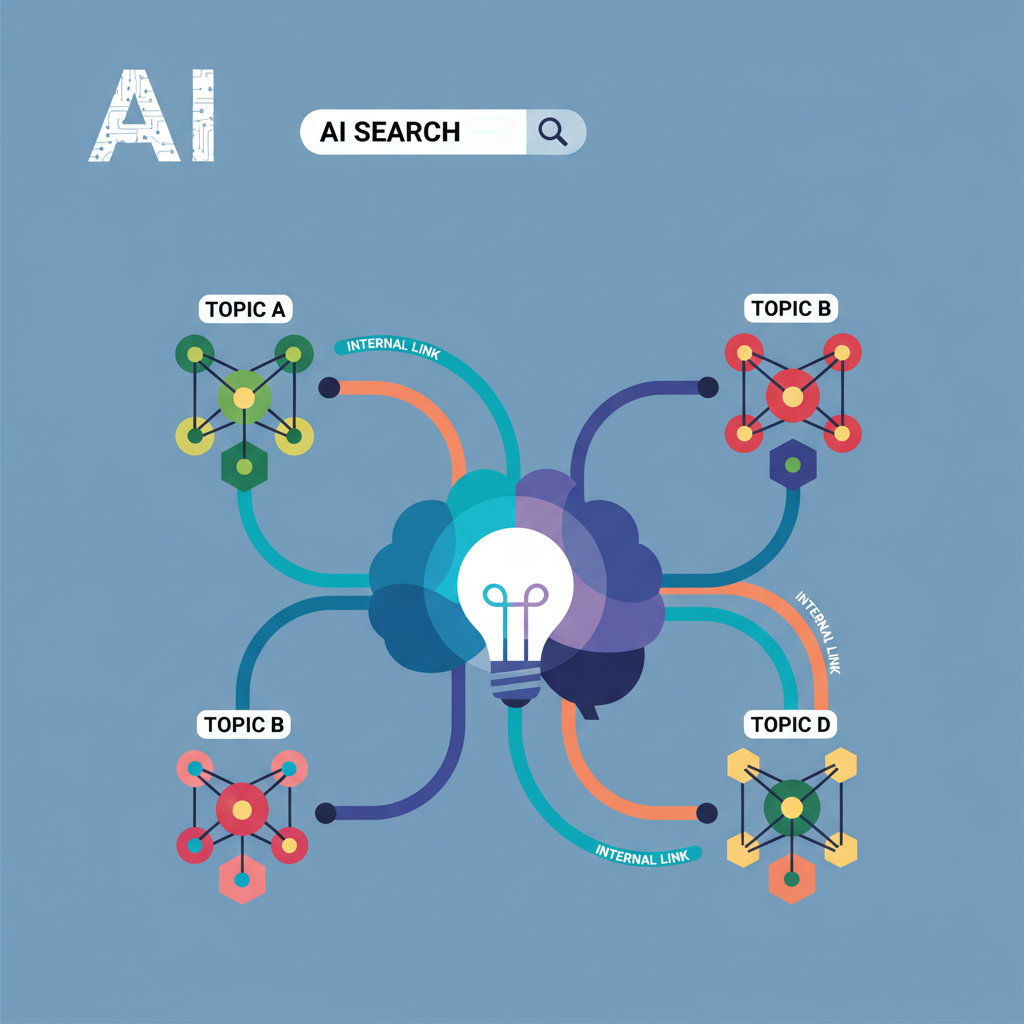
Internal linking and topical clustering is a system for organizing a website's content by topic: a central pillar page anchors a set of focused cluster pages, tied together with deliberate internal links that show depth and relationship. The accepted baseline is the hub-and-spoke model (one broad pillar at the center, clusters around it, connected by internal links) built originally to help crawlers discover pages and consolidate PageRank-style authority. What's changed is that AI answer engines now read those same clusters to retrieve, chunk, and cite self-contained answers, so the old rules only partly still apply.
In its simplest form the system has three parts working together. The pillar page defines the core topic, sets its boundaries, and provides the map to the subtopics. The cluster pages each answer one specific sub-question thoroughly without repeating the pillar's overview. The internal links are the connective tissue that makes those relationships explicit, signaling to both readers and systems that these pages belong to the same topical group and should be understood together.
That baseline definition raises the real question: which of those linking rules still hold, and which ones need to change, once an AI engine (not a crawler) is the one reading your site.
The classic internal linking rulebook for pillar/cluster SEO is a three-part hub-and-spoke system: the pillar page links to every cluster page, each cluster page links back to the pillar, and cluster pages only link sideways when topics genuinely overlap. Moz's May 8, 2025 cluster guide and Google's current Search Central documentation still teach that pattern as the baseline for topical authority.
Here's the rulebook every SEO source already teaches for crawler-facing linking.
Pillar → cluster: The pillar acts as the hub and contains a crawlable link to each supporting piece. Google's SEO Link Best Practices notes that Google finds new pages through links and that links must be standard <a> elements with an href to be reliably parsed, with descriptive, concise anchor text that sets expectations.
Cluster → pillar: Every cluster article links back to the pillar with topical anchor text. Moz's topic cluster guide describes this as the core linking model that creates a clear hierarchy.
Cluster → cluster: Link only where there is a real lateral relationship, not to every peer by default.
Why this pattern still matters for classic rankings:
nofollow only when you don't trust a source, not as a sculpting tactic.Verdict: Google's docs confirm crawlable links with descriptive anchors still aid discovery, while hoarding equity with blanket nofollow is dated folklore per current nofollow guidance.
Those rules were designed for a system that crawls links one at a time. AI engines don't read that way; they retrieve chunks and match entities. Here's what that changes.
AI retrieval engines read topical clusters as collections of retrievable passages matched by semantic similarity, not as pages ranked by link equity. Retrieval-augmented generation (RAG) systems split external documents into small passages, convert them to vector embeddings, and rank those passages against a user query by mathematical similarity before the answer is generated.
Classic Google Search is page-level. Google states its ranking systems are designed to work on the page level and that it uses link analysis systems including PageRank to understand what pages are about. Its passage ranking system then identifies individual sections or "passages" of a web page to judge relevance, but discovery and authority still travel through the link graph.
RAG-based answer engines invert that order. According to AWS, RAG is the process of optimizing the output of a large language model, so it references an authoritative knowledge base outside of its training data sources. The implementation steps matter for clustering: embedding models convert data into numerical representations stored in a vector database, the user query is converted to a vector representation and matched with the vector databases, and relevancy is calculated using mathematical vector calculations. To manage scale, systems like Amazon Kendra's Retrieve API are built to retrieve up to 100 semantically-relevant passages of up to 200 token words each, ordered by relevance.
That creates a gap every source currently cited in AI Mode for "Internal Linking and Topical Clustering" — InLinks, Moz, RankMath, Siteimprove, machined.ai, Finsweet — misses: none connect cluster design to chunk-level retrieval, entity disambiguation, or passage-level citation likelihood. They frame clustering only as crawl efficiency and PageRank distribution.
In retrieval-system terms, the pillar/cluster/link-equity vocabulary maps like this:
A page can have strong internal link equity and still never be cited, because the retriever never finds a single self-contained passage that semantically matches the question with clear entity context. If your pillar defines an entity and your clusters use vague pronouns, split definitions across pages, or bury the answer in a long page without a quotable chunk, the vector match fails even if the page ranks.
Quick decision framework — does a cluster page pass the retrieval test?
A page failing two or more of these is a candidate for rewriting before it's a candidate for more internal links.
An AI-citable topical cluster is built when every pillar and cluster page is engineered as a collection of self-contained chunks, each with a clear H2/H3, a direct-answer first sentence that states the full entity name, and internal links that reinforce entity relationships. Here's how to build or audit a cluster against that standard.
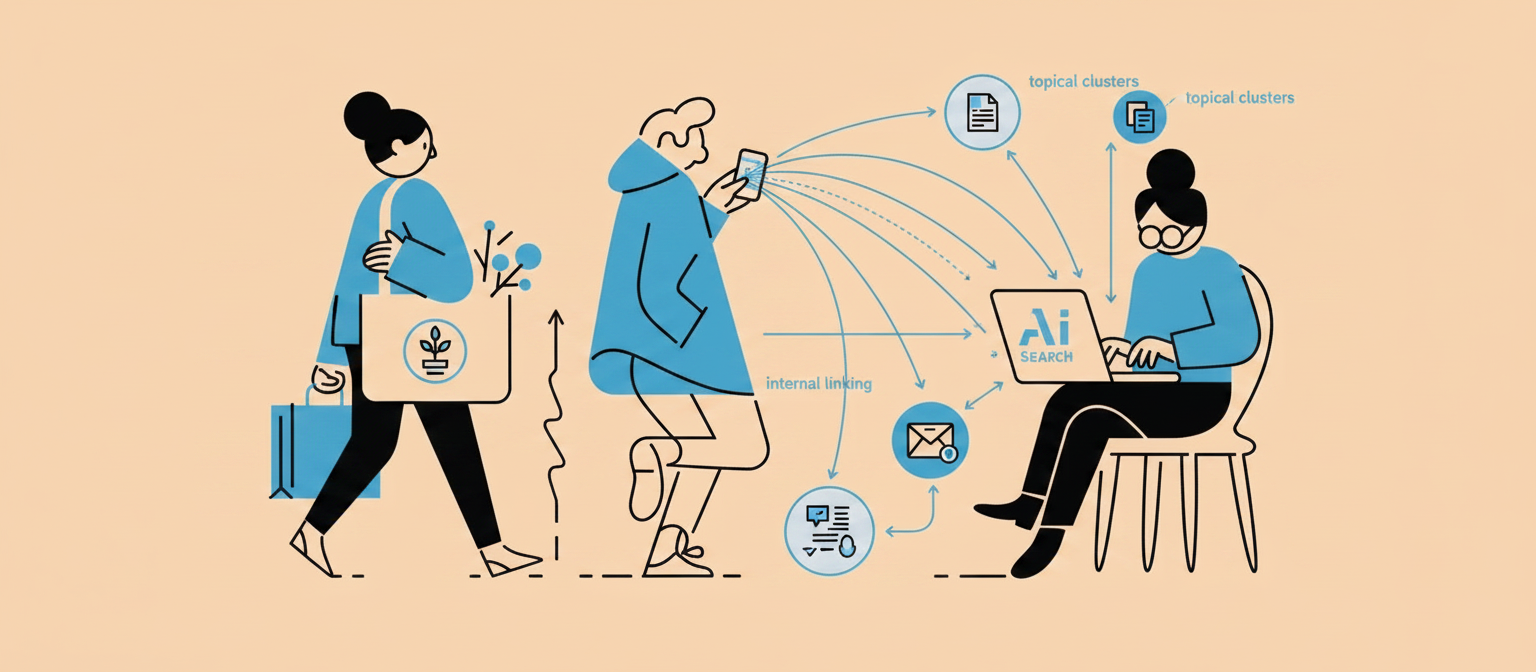
Make every section retrievable on its own. Open each H2/H3 with a direct answer that could stand alone if extracted, and keep sections focused on one subtopic so a retriever never mixes unrelated ideas in a single chunk.
Define the entity before you explain it. First mention in a page or section should give the full name plus a one-line definition, then use that exact name consistently. Inconsistent short names break entity matching.
Rewrite anchors for disambiguation. Google's own guidance is to use descriptive anchor text that describes the destination and avoid generic phrases like "click here" (descriptive anchor text best practices). In a cluster that means linking the full concept name when pointing to a sub-guide.
Keep boundaries clean. Retrieval systems perform best with strategies like "by title" chunking that preserves section boundaries so topics remain self-contained. Don't let a paragraph about tool comparisons bleed into a definitional paragraph.
Audit for citability gaps:
Maintain consistent voice and naming across pages. When definitions and entity labels drift, chunks look like different entities to the retriever. Documenting naming rules in your brand voice and content standards prevents that drift.
A framework tells you what to do; these are the specific ways clusters quietly fail even when the linking looks correct on paper: four silent failure modes are thin cluster pages that duplicate the pillar at the chunk level, generic anchor text that strips entity signals, orphaned pages with no inbound internal links, and internally consistent clusters that never earn an external citation.
1. Thin duplicates that cannibalize at the chunk level. When cluster pages rephrase the pillar instead of adding a distinct sub-answer, retrieval systems see multiple near-identical chunks competing for the same query. Ahrefs describes this pattern as keyword cannibalization occurs when two or more pages compete for the same query and hurt overall organic traffic. For AI retrieval the penalty is not just ranking dilution: the model cannot decide which chunk to pull, so it pulls neither.
2. Generic anchor text with no entity signal. Anchors like "click here," "learn more," or "read more" tell a crawler where to go but tell a vector store nothing about what the target chunk is about. Moz notes anchor text is still considered for internal links and the first anchor is what systems apply. In a RAG context, generic anchors waste your best chance to label the cluster relationship for entity disambiguation.
3. Orphaned cluster pages. A page that exists in the sitemap but receives no inbound links from the pillar or siblings is invisible to both crawlers and cluster-aware retrieval. Moz's analysis warns that a lack of internal links can seriously hamper a page's ability to get crawled and ranked, with orphan pages as the textbook case. If an LLM never sees the page connected to its topical family, it cannot cite it as part of that family.
4. Closed-loop clusters with no external validation. A perfectly interlinked hub that no independent source ever references looks self-referential. Answer engines weight independent citations as trust signals for whether a cluster is authoritative enough to cite. Without even one external reference pointing into the cluster, the whole graph stays low-confidence.
The most common silent killer is generic anchor text: a well-linked cluster using only "learn more" anchors never gives the retrieval model the entity labels it needs to cite you.
The mistakes above are fixable individually, but clusters aren't static; the real question is how to keep them correct as they grow. Maintaining topical clusters at scale means choosing between periodic manual audits and an ongoing automated linking process, depending on site size and publishing velocity. Small sites with a handful of pillars can stay accurate with seasonal manual checks, while blogs publishing often or agencies managing several clients see clusters decay quickly if new pages do not update pillar links and entity definitions.
HarperFlow publishes highly structured articles featuring FAQs, data tables, and direct-answer blocks that meet the rigorous citation standards required by AI search engines. By continuously auditing and improving your content through AI answer analytics, HarperFlow helps your site build long-term authority and visibility that outlasts ad-dependent strategies.
Use a simple decision rule. If you manage a small set of pillars and publish only a few posts each month, a manual process works: keep a sheet listing each pillar, its cluster URLs, and the anchor phrases that define the entity, then on every new publish add bidirectional links and review the pillar intro for drift. Reserve time per publish for that check and log the date.
If you publish frequently or run multiple Webflow blogs, manual upkeep breaks. New cluster pages ship without updating the pillar, anchors drift, and voice shifts across authors. At that point you need linking and memory enforced in the publishing pipeline itself, not as a separate audit.
An operational option is HarperFlow, whose automated pipeline builds internal linking and brand-voice memory into every article it publishes to Webflow, which helps keep a cluster's AI-citability intact as it grows.
Either way, the job of a topical cluster now is to prove authority to Google's crawler and to an AI retrieval system at the same time, and your linking discipline has to serve each.
No. The classic model is pillar links to cluster and cluster links to pillar, creating a clear hierarchy, and you should add cluster-to-cluster links only where there is a real topical overlap. Linking every peer by default dilutes surrounding-text signals and creates noisy entity edges without improving semantic proximity.
Google can only crawl your link if it is an HTML element with an href attribute. Buttons, divs with click handlers, or links injected late by JavaScript can leave cluster pages orphaned. Render the pillar to cluster and cluster to pillar connections as plain HTML with descriptive anchors.
You should not. Use nofollow only when you don't trust the source, and not for every external link or for internal sculpting. Internal links distribute link equity across your cluster and every page you care about should have a link from at least one other page.
Good anchor text is descriptive, reasonably concise, and relevant, and you should avoid generic text like Click here or Read more. For AI the anchor works as an entity label that disambiguates the target, and Moz notes anchor text is considered for internal links with the first anchor counting.
Keyword cannibalization is when two or more pages on your website rank for the same search query and compete in a way that hurts overall organic traffic. For retrieval, near-identical chunks cause the model to struggle to pick a source, so rewrite each cluster to answer one distinct subtopic and keep section boundaries clean.
A lack of internal links can seriously hamper a page's ability to get crawled and ranked, which is the classic orphan page problem. Google states internal linking helps users and Google navigate your site and find other pages. In AI retrieval, the page also loses its edge in the entity graph, so it is never seen as part of the family.
Yes. Google's passage ranking identifies individual sections or passages to judge relevance, and retrieval systems work best when by title chunking preserves section boundaries so topics remain self-contained. If you blend multiple subtopics in one heading, no single chunk will provide a clean vector match.
Yes. A perfectly interlinked hub with no independent references looks self-referential and stays low-confidence for answer engines. The decision framework in the article flags a page that lacks any external source referencing it as a citability risk. At least one external reference into the cluster raises trust that the entity graph is authoritative.