This article defines internal linking and topical clustering for AI search and explains why PageRank-era equity models fail for passage-level RAG retrieval. It contrasts classic SEO rules with GEO-adapted rules for anchor text, placement, density, and sibling linking, details pairing BreadcrumbList and FAQPage schema with links, and provides a five-step audit for AI-citation readiness, concluding that fixing orphans, generic anchors, and missing markup beats expanding.
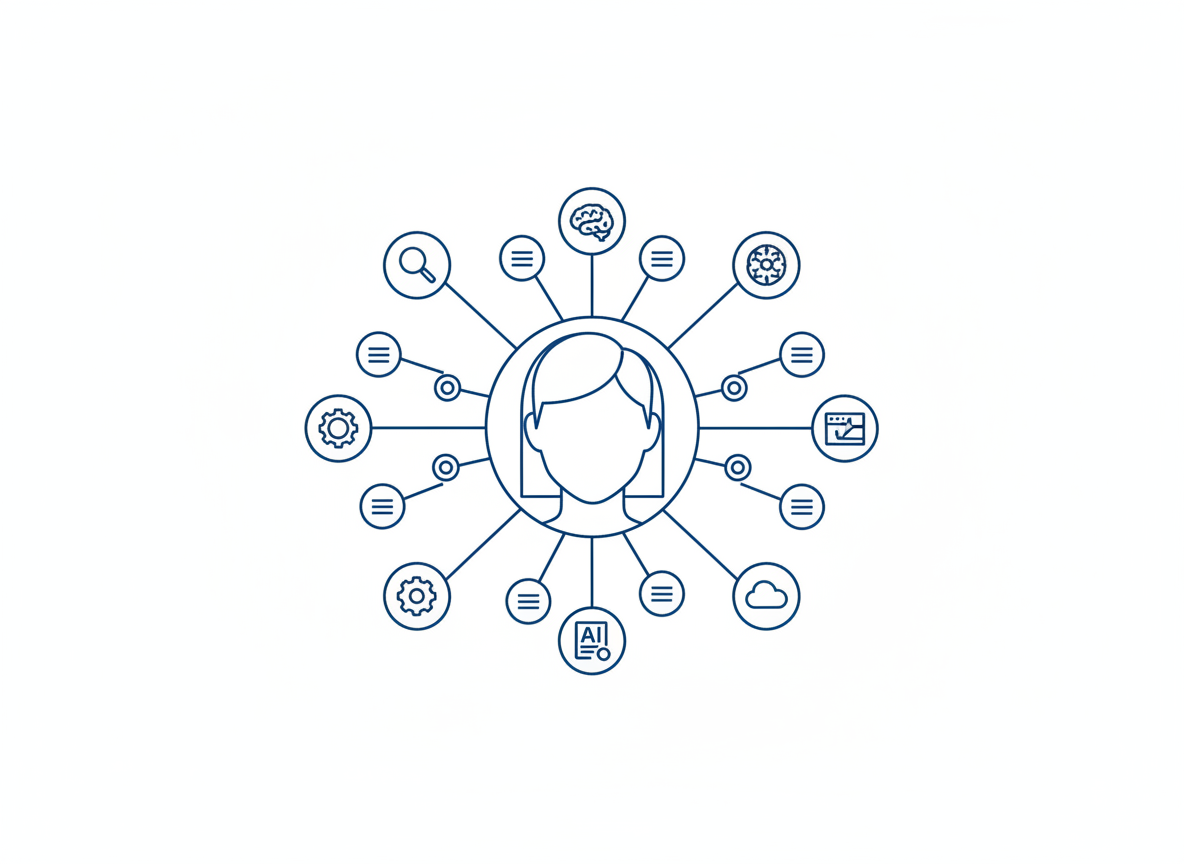
Topical clustering is grouping related pages under a central pillar page with deliberate internal links to signal you own a subject, while internal linking is the hyperlinks connecting those pages within your own domain. For AI search, this matters differently now because answer engines like Google AI Mode, Perplexity, and ChatGPT retrieve and cite specific passages and chunks, not just crawl whole-site link graphs to distribute PageRank. Internal linking rules built for PageRank distribution are necessary but not sufficient for AI-citation retrievability. Link structure must also support chunk-level answerability.
The classic model everyone knows is the hub-and-spoke: a pillar or hub at the center, cluster pages that go deep on subtopics, and bidirectional internal links tying them together for users and crawlers. That structure is still the baseline for organization and authority, because topic clusters must follow an interlinking structure that tells search systems those pages belong together.
What changes for AI search is what those links need to prove. When a system pulls a single paragraph to answer a question, the link context around that paragraph determines whether the engine treats it as an isolated page or as evidence of comprehensive topical authority. If the surrounding cluster makes the meaning explicit and the connections obvious, that chunk is far more likely to be retrieved and cited. The mechanics behind clustering therefore look less like crawl-budget management and more like designing a semantic map for retrieval.
Crawlers and retrievers read your site differently now, and the gap between the two models is mechanical, not philosophical.
Classic search builds a link graph. Google's link analysis systems understand how pages link to each other as a way to determine what pages are about and which might be most helpful in response to a query, with PageRank distributing authority through those edges. In that model, internal linking mostly controls crawl budget and authority flow; a page three hops from the homepage still counts if the bot eventually finds it.
AI answer engines add a second, chunk-level step. Google now uses an AI system to identify individual sections or "passages" of a web page to better understand how relevant a page is to a search, not just whole-page signals. For RAG-style systems this gets more literal: you create text embeddings of pieces of data and place them in semantic space, then match a query vector against chunk vectors. The goal is to store the semantic meaning of a document and its constituent parts so an LLM can retrieve based on query strings, and practitioners report better luck when you create smaller semantically coherent units that correspond to potential user queries, a point made in this breakdown of chunking strategies for RAG.
That changes what hurts you:
This sets up the next piece: how to adapt anchor phrasing, link depth, and link placement so each chunk can be found, understood, and quoted.
That shift from page-level crawling to passage-level extraction only becomes useful once it's translated into link-by-link decisions. Classic guidance treated links as equity pipes. The GEO version treats them as labeled edges in a topic graph a model can read and cite.
| Linking Element | Classic SEO Rule | GEO-Adapted Rule for AI Citation |
|---|---|---|
| Anchor Text Practice | Use descriptive, keyword-relevant anchor text and vary phrasing to avoid over-optimization | Use entity-anchored, topic-descriptive anchors that name the destination as a thing; avoid format claims like "my guide" |
| Links per Page / Density | No strict limit but legacy guidance notes rough crawl limit of 150 links per page, typically kept around 100 or less for usability | Fewer highly relevant links per section; prioritize relevance and in-passage placement over total count |
| Pillar-to-Cluster Flow | Hub-and-spoke pyramid where pillar distributes link equity to clusters and clusters link back to pillar | Pillar owns the entity; cluster pages embed pillar link inside claim passage to signal ownership and make pillar citable |
| Sibling / Lateral Linking | Optional, mainly for user navigation | Required for topic graph; link sibling pages with relationship-specific sentences to show how entities connect |
| Link Placement | Anywhere on page passes equity, including nav, footer, sidebar widgets | Embedded inside prose of the specific passage the claim belongs to; avoid callout boxes and related-post blocks for primary semantic links |
| Topical Boundaries / Dilution | Cross-topic linking acceptable if useful for users | Avoid mixing semantically distant destinations inside same passage; keep cross-cluster links sparse and explicitly framed |
The clearest change is anchor text. Classic best practice already called for descriptive anchor text to help search engines understand the context of the linked page. For AI citation that description needs to name an entity, not a format: "internal linking for GEO" or "latest research on churn rates" instead of "my ultimate guide" or "click here." When that anchor sits inside the sentence that makes the claim, its meaning travels with the chunk the model extracts.
As documented in recent GEO testing, links become a section-level signal, not a page-level one, and "Further Reading" callouts put links where they do the least for AI citation because their text falls outside the extracted passage. That makes placement a rule, not a preference: embed the primary internal link where the claim lives, not in a box below it.
Sibling linking also flips from optional to architectural. In the classic model lateral links were mainly for navigation. For AI citation they are semantic edges that show how entities within a cluster relate, which helps systems assess depth of coverage. The inverse rule matters just as much: packing a single passage with links to semantically distant topics dilutes the graph and blurs ownership. Keep each section to a few tightly related links, reserve cross-cluster links for explicit bridges, and let the pillar remain the single node every page in the cluster references inside claim prose.
Those edges are only as readable as the labels around them, which is where structured data and heading hierarchy reinforce the linking work for machine parsing.
Building on the linking-rules table, the next layer is making those relationships machine-readable. Internal links show the path; structured data labels it so answer engines don't have to infer it.
Beyond just keywords, AI engines prioritize well-structured content with clear metadata, FAQs, and schema markup. HarperFlow automates these optimizations, ensuring your content is highly discoverable and relevant, reducing manual work while boosting answer engine performance.
A BreadcrumbList is the clearest reinforcement. Google's documentation defines a breadcrumb trail as indicating the page's position in the site hierarchy and notes that a valid BreadcrumbList must contain at least two ListItems. When your pillar is 'Internal Linking Guide' and a cluster page is 'Anchor Text for Entity Matching,' the visible breadcrumb and its JSON-LD mirror the same hierarchy: Guide > Anchor Text. That redundancy is useful. Even if a retriever lands deep in the cluster, it receives an explicit parent-child signal rather than guessing from URL patterns.
On the page level, pair that with typed content markup. Article schema supplies headline, datePublished, author and about properties that identify what the page is about, while FAQPage exposes discrete question-answer pairs as defined by schema.org as a WebPage presenting one or more Frequently asked questions. Instead of burying definitions in prose, you mark a concise Q&A, such as 'What is topical clustering?', with Question and acceptedAnswer, which gives answer engines a pre-chunked, citable unit that already sits inside the cluster.
Heading hierarchy and metadata do the same work at lower cost. Keep one H1 matching the Article headline, use H2s for the entity questions your internal links point to, and align title and meta description to the entity, not a generic keyword. The link says 'learn about entity-anchored anchors,' the H2 says 'Entity-anchored anchor text,' and the schema says the page is about that entity: three signals pointing the same way.
For teams maintaining dozens of clusters, keeping those three signals in sync by hand breaks quickly. This is where automated pipelines fit: HarperFlow, for example, automates cluster-mapping, link insertion, and structured formatting together so the schema updates when the internal graph changes. With that wiring in place, auditing whether the cluster actually reads as a coherent semantic graph becomes the next task.
The entity-anchored linking rules and structured-data pairing above turn into a runnable audit for any pillar-and-cluster set this week. Run it as a five-step checklist against one cluster at a time:
1. Orphan and equity scan. Export internal links with Screaming Frog, Sitebulb, or Search Console Links. Flag any cluster URL with zero contextual inbound links from its pillar or siblings. Those orphans cannot pass or receive topical signals, no matter how good the content is.
2. Anchor specificity pass. Pull anchor text for all intra-cluster links. Mark generic anchors like "click here," "learn more," or raw URLs. Replace them with entity-specific anchors that match the target page's primary entity, as defined in your earlier linking rules.
3. Placement and density check. For most cluster pages, a modest set of internal links placed directly in the body copy (not in sidebar or "related posts" widgets) outperforms a heavier link count. Links should sit near the definitional sentence or proof point they support; treat total count as secondary to relevance and placement.
4. Structured data presence. Confirm each page has the markup types you mapped earlier present and valid in-page. No need to re-implement here, just validate: if a FAQ cluster page lacks its paired markup, it fails this gate.
5. Independent quotability test. Copy two key passages per page into a blank doc. Can a reader understand the claim, entity, and context without the surrounding article? If it only makes sense with the intro, add a self-contained definition sentence and an explicit entity mention.
When resources are limited, fix in this order: reconnect orphans, rewrite generic anchors, restore missing structured data, then improve quotability. Only after those pass should you create new cluster pages.
One-line verdict: fix orphan pages, generic anchors, and missing structured data before investing in new cluster content, retrofitting readiness beats expanding an unreadable cluster.
Aim for relevance over volume. Legacy crawl guidance noted a rough limit of 150 links per page, typically kept around 100 or less for usability, and for AI search you want even fewer highly relevant links per section placed inside the claim passage itself. Fix placement and anchor specificity before adding more links.
They are not harmful for crawling, but they put links where they do the least for AI citation because the link text falls outside the extracted passage. Keep them for user navigation if you want, but do not rely on them for your primary semantic links; embed the important internal link inside the prose where the claim lives.
Yes, entity mentions reinforce internal linking even without a hyperlink, because they help retrieval systems associate the passage with the broader topic graph. A plain mention is weaker than a descriptive, entity-anchored link, so use mentions to support, not replace, your intentional internal links.
Use a BreadcrumbList that contains at least two ListItems and ensure the visible trail shows the page position in the site hierarchy, like Pillar > Cluster page. That structure gives answer engines an explicit parent-child signal that mirrors your internal linking, even when they land deep in the cluster.
In classic search an orphan might still be found eventually through sitemaps and lose some equity, but for AI retrieval it may never enter the candidate set for similarity search or it gets chunked without neighboring context. Google now identifies individual sections or passages to judge relevance, so a passage without cluster context loses meaning in the embedding space.
You can, but keep cross-cluster links sparse and explicitly framed. Avoid mixing semantically distant destinations inside the same passage, since that blurs topical ownership and dilutes the embedding signal. When you do bridge clusters, add a relationship sentence that explains why the topics connect.
Old SEO needed descriptive anchor text to help search engines understand the linked page context, which still applies. For AI citation the anchor should name the destination entity rather than the format, for example use internal linking for GEO instead of my ultimate guide, so the anchor aligns with query vectors during embedding matching.
Yes, sibling linking is now required for the topic graph, not just optional navigation. Lateral links with relationship-specific sentences show how entities within the cluster connect, which helps answer engines assess depth of coverage and can make cluster pages citable for more specific queries.
HarperFlow publishes highly structured articles featuring FAQs, data tables, and direct-answer blocks that meet the rigorous citation standards required by AI search engines. By continuously auditing and improving your content through AI answer analytics, HarperFlow helps your site build long-term authority and visibility that outlasts ad-dependent strategies.
Start Your Trial TodayLover of all things automation and all things content.
Your privacy
Necessary storage keeps the site secure and working. With permission, analytics helps us improve it and marketing tools measure campaigns. Google can still send limited cookieless signals when optional storage is off. Read our Privacy Policy.
Your browser sends a privacy signal (Global Privacy Control), so optional technologies start off — your choice here takes precedence.
Privacy choices
Necessary storage supports security, consent, and the features you request. Optional categories can be changed at any time.
Security, fraud prevention, consent preferences, form delivery, and popup suppression.
Your browser sends a Global Privacy Control signal, so optional technologies start off by default. Your explicit choice here takes precedence.
A practical AEO/GEO manual for making your Webflow site clearer, better sourced, and easier for answer engines to use—without gimmicks or guarantees.
Find gaps in discovery, extraction, evidence, authority, and freshness
Use evidence patterns, briefs, and fill-in worksheets
Run a focused 30-day AEO/GEO operating sprint
We’ve emailed your copy. It should arrive within a few minutes.
If it is not in your inbox within a few minutes, check spam or promotions.