This guide explains how to measure AI search referral traffic beyond default analytics. It shows how to build a custom GA4 AI Search channel with regex, validate with server logs and user-agents, infer Google AI Overview impact via Search Console divergence, and confirm influence with branded query lift and citation monitoring. It concludes traffic must be verified across four layers and tied to conversions before acting.
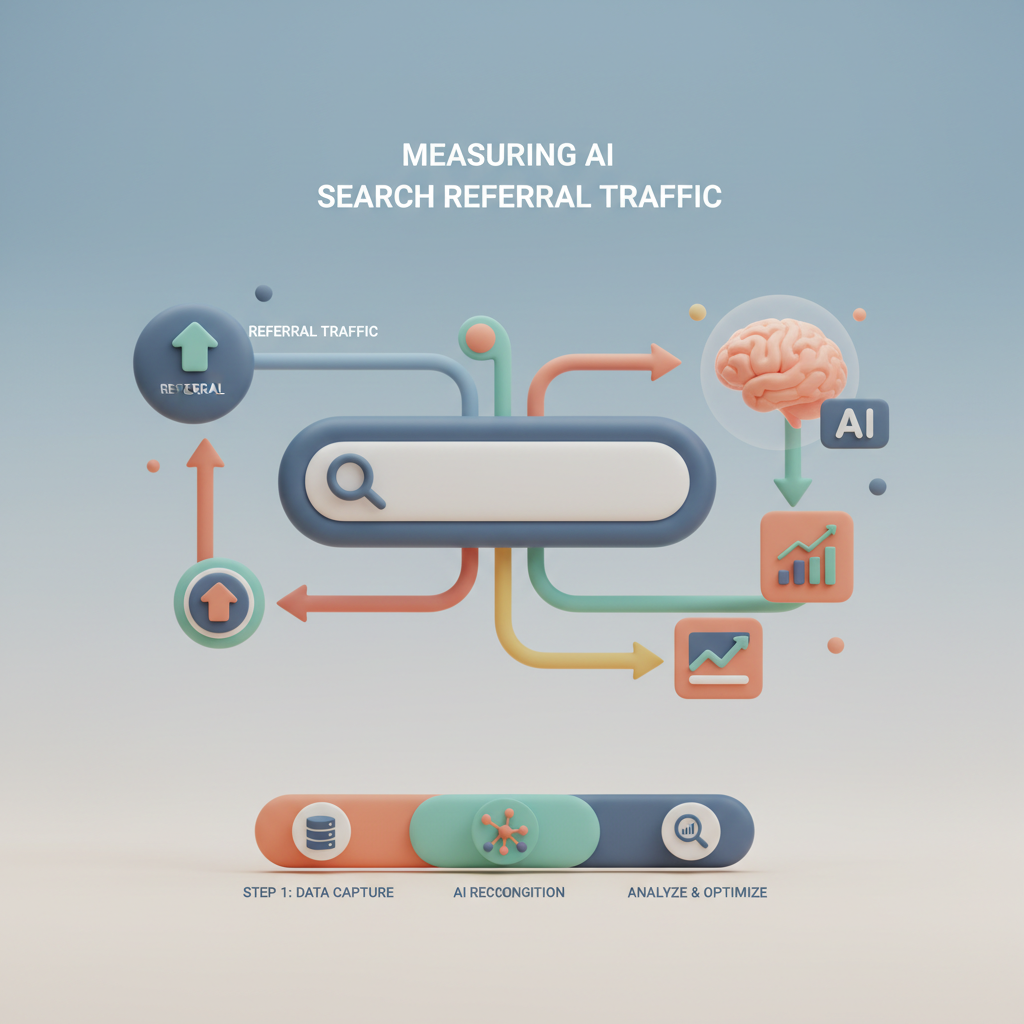
AI search referral traffic is any session that arrives when a user clicks a link inside an AI-generated answer, from ChatGPT, Perplexity, Gemini, Copilot, Claude, You.com, and similar engines, or when traffic can be reasonably inferred from Google AI Overviews and AI Mode. You measure it by combining direct signal capture with indirect inference: GA4 channel grouping and server logs for known AI sources, Search Console divergence analysis for Google's AI surfaces, and branded-query and citation tracking to catch demand lift even when no click is logged.
No single platform reports the full picture. Direct detection looks for AI domains in referrers and user-agents; indirect inference fills the gaps where Google bundles AI Overview clicks into organic and where in-app browsers strip referrers entirely.
In practice that means building four sequential layers: GA4 channel grouping for known AI sources, server-log and user-agent validation to confirm what analytics missed, Search Console divergence analysis for Google AI Overviews, and branded-query and citation proxy tracking to catch demand lift even when no click is logged. Each layer catches a different slice and carries its own blind spots, so the framework verifies rather than simply counts.
A meaningful share of AI referrals arrive with no referrer header at all, depending on the platform and app context, so they're still easily misread as Direct or Referral without a dedicated channel view. That gap is why a single-tool count understates true impact.
The first concrete layer to build is direct measurement inside your existing analytics stack.
Once you know what qualifies as AI referral traffic, the first job is capturing what your analytics tools can actually see directly.
GA4's default channel definitions still miss most of this traffic. Until you add your own rules, sessions from AI assistants are often classified as Direct because the referrer header was stripped by an in-app browser, or as generic Referral because the source domain was not in Google's default list. The result is a quiet undercount that looks like no AI traffic at all.
GA4 has been rolling out native recognition for some AI assistants, but coverage is inconsistent. Perplexity is not reliably included and Claude's status remains unconfirmed, so a custom group is still the only way to get complete coverage. The setup lives at Admin > Data Display > Channel Groups and is evaluated top-down.
chatgpt\.com|chat\.openai\.com|openai\.com|perplexity\.ai|claude\.ai|gemini\.google\.com|bard\.google\.com|copilot\.microsoft\.com|bing\.com/chat|deepseek\.com|grok\.com|meta\.ai|you\.comchatgpt or Page referrer contains utm_source=chatgpt.com, since ChatGPT appends that UTM on some links even when referrer is missing.This current AI referrer regex breakdown reflects the platforms driving the large majority of measurable AI referral traffic as of mid-2026. Review it quarterly as new tools appear.
Referrer-based detection only works when the browser sends a referrer. For complete telemetry, check what actually hit your origin.
In raw server logs or CDN logs, filter for the AI referrer domains above, plus bot user-agents like OAI-SearchBot and PerplexityBot to see crawl activity that predicts future citations. In Adobe Analytics or Customer Journey Analytics, use derived fields to define data manipulations on the fly through a customizable rule builder to build an equivalent dimension, for example a Marketing Channel rule that says if Referrer CONTAINS perplexity.ai OR chatgpt.com then set to AI Search. Tools like Spyglass or custom edge workers can apply the same logic before data reaches GA4.
Without a custom channel group, GA4 will silently bucket most AI referrals into Direct or unassigned Referral, so a near-zero AI Search number in default reports is a false negative, not proof of no traffic.
Direct detection only catches traffic that still carries a referrer or UTM. Google's own AI Overviews leave no such trail at all, which forces a different, inferential approach.
Direct detection covers chatbot click-throughs, but Google's largest AI surface (AI Overviews) leaves no trail to detect directly, so measurement here means reading a pattern instead of a referrer.
Google does not pass a distinct referrer for AI Overview citations. A click on a source link inside an Overview arrives with a standard google.com referrer and is logged as ordinary Google organic traffic in GA4. Search Console historically offered no built-in filter that isolates AI Overview impressions specifically, so you cannot cleanly filter Performance to "AI Overview only" without newer native reporting (see below).
The workable proxy is divergence analysis in GSC Performance:
That flat-impression / down-click shape is the tell: Google still shows your URL for the query, but the answer is satisfied on-SERP.
A declining pattern alone is not proof. A false signal looks like impressions and clicks falling together (seasonal demand drop), position dropping sharply across many queries on the same dates (algorithm update), or another of your own pages gaining the same query while this one loses it (internal cannibalization). A genuine AI Overview divergence keeps impressions and position intact while CTR decays on informational queries you can manually verify trigger an Overview in search results.
Check your property for newer native reporting. In June 2026 Google announced dedicated views of your impressions within generative AI features on Search, such as AI Overviews and AI Mode in Search Console. If that report is available to you, validate divergence candidates there before concluding.
Even a well-read divergence pattern is circumstantial. The strongest confirming signal for real AI-driven influence shows up somewhere else in your data entirely: branded search.
Branded search lift is the confirming signal, but on its own it's still just one data point. The real value comes from reading all four layers together.
In Google Search Console, filter Performance to queries that contain your brand name and track impressions and clicks over several weeks. A sustained rise that cannot be tied to paid search, PR, or product launches often trails AI citation activity, because users learn the brand inside an answer and later Google the name to visit. Compare your branded trend against your media calendar and ad spend to rule out other causes.
To make branded lift attributable, keep a prompt log. Build a working set of high-intent buyer questions, run them consistently across ChatGPT, Perplexity, Gemini, and Copilot on a regular cadence (weekly is a reasonable starting rhythm) and record whether your brand or domain appears with a clickable citation. You can express the result as a rough Share of Voice: brand citations as a share of total AI answers triggered for your tracked query set. That log shows whether a lift in branded searches aligns with more frequent citations, rather than coincidence.
Direct AI referrals are still low volume for most B2B sites, typically low single-digit percentages of sessions. With counts that small, a week-over-week change that looks dramatic can be random noise. Avoid reacting to weekly swings. Use rolling averages, minimum sample thresholds, and month-over-month comparisons before concluding that AI referral influence is rising or falling.
This comparison gives you a structured decision framework:
| Measurement layer | Primary tool | What it detects | Key limitation / noise risk |
|---|---|---|---|
| Direct referrer detection | GA4 custom channel group | Clicks that arrive with an AI referrer like ChatGPT or Perplexity | Undercount; app and private contexts pass no referrer and fall into Direct, so channel is a floor |
| Server-log / bot detection | CDN / web server logs | Fetches from AI crawlers and browsing modes via user-agent | Noisy; mixes crawler activity with human referrals and needs log access |
| Google AI Overviews inference | Google Search Console | Indirect influence of AI Overviews inside organic search | Cannot isolate AI Overview clicks from organic; zero-click mentions invisible |
| Branded lift + citation proxy | GSC + weekly prompt testing | Downstream demand and how often brand is cited across engines | Lagging indicator; correlates with PR and paid, requires consistent weekly logging |
Use it sequentially for verification. First, check the direct signal in your custom channel group and server logs: is there any referrer-based traffic that survived to analytics? Second, check the inference layer in Search Console: does organic behavior suggest AI Overview influence? Third, check the proxy layer: do branded queries and citation logs tell the same story? Confidence is highest when at least two layers agree and the timeline aligns. One isolated layer with tiny counts is a hypothesis, not proof.
With a verified traffic signal in hand, the last question is what to do with it, specifically, whether that traffic is actually worth anything.
A verified, low-noise reading of AI referral traffic is only useful if it changes what you do next. Once you have a clean AI-referral segment defined, apply your existing business outcomes to it so you can answer whether those visits produce pipeline, not just sessions.
Beyond just keywords, AI engines prioritize well-structured content with clear metadata, FAQs, and schema markup. HarperFlow automates these optimizations, ensuring your content is highly discoverable and relevant, reducing manual work while boosting answer engine performance.
Tie the isolated segment to conversion value in GA4: keep the segment you already built and view it against your marked key events (form submits, demo bookings, email captures) and, where relevant, purchase and revenue events. Look at conversion rate, revenue per session, and assisted pipeline for that segment versus Google organic and branded direct baselines for the same period. Keep the comparison window to 90 days minimum because AI referral volume is still thin for most sites.
Current independent evidence points in one direction even if the exact multiple varies by study: AI-referred traffic tends to convert meaningfully higher than standard organic search. Seer Interactive's single-client analysis reported Google Organic at 1.76% conversion while ChatGPT reached 15.9% and Perplexity 10.5% for the same key events. A cross-industry review of studies from 2025-2026 found AI-referred visitors converting at a notably higher multiple of the rate of standard organic search on average (figures vary by source, so treat any specific multiple as directional) with wider spread by category.
The proposed mechanism is pre-qualification: the visitor has already filtered options inside the answer engine, so the click arrives later in the research journey. That also explains outliers where ecommerce impulse categories underperform organic.
Treat citation work as validated only when three signals align over at least two consecutive months: repeat citation logging for target queries in ChatGPT and Perplexity, a sustained lift in branded query volume and branded direct that exceeds seasonality, and direct AI referral sessions that meet your baseline conversion rate or revenue per session. One signal alone is noise. A short spike, a single cited answer, or a handful of sessions without conversion is a reason to keep producing and monitoring.
This tracking framework is the feedback loop for whether citation-optimized, structured content is actually converting. The kind of content a pipeline like HarperFlow is built to produce (with traceable sources, FAQ blocks, and metadata structured for answer extraction) is on the production side; this measurement tells you if that production is earning referral sessions and branded lift.
A single month of AI referral data is not a verdict. Treat the framework as a rolling, monthly review rather than a one-time audit, since both traffic volume and attribution signals are inherently noisy and context-dependent.
Monthly review checklist:
Many AI apps open links in an in-app browser that strips the referrer header, so there is nothing for a source regex to match. Add a secondary condition for utm_source=chatgpt.com and check server or CDN logs where the referrer may still exist at origin. GA4 will still undercount, so treat the custom channel as a floor, not the total.
Yes. New browsing surfaces appear regularly and GA4 native recognition does not reliably include Perplexity, so a custom group is still required. Keep the base pattern covering chatgpt.com, perplexity.ai, claude.ai, gemini.google.com and others, and review current AI referrer patterns quarterly.
A genuine AI Overview signal is impressions holding steady while CTR falling on high-intent queries that you can verify trigger an overview in search results. If impressions and clicks fall together, or average position drops sharply across many queries on the same dates, it points to seasonal demand or an algorithm update instead.
Google announced reports designed to give you dedicated views of your impressions within generative AI features on Search, such as AI Overviews and AI Mode. If the report is rolled out to your property, use it to validate divergence candidates first, because without it Overview citation clicks are still logged as google / organic in GA4.
Use CDN or edge worker logs if available, and lean on the behavioral proxy layers. In Adobe you can build the same logic with derived fields that allows you to define data manipulations on the fly through a customizable rule builder. Even without origin logs, aligning GA4 custom channel, Search Console divergence, and branded lift over 90 days raises confidence.
AI referrals are typically low single-digit percentages of sessions for most B2B sites, so weekly swings are usually noise. Use a minimum 90-day rolling window and require repeat citation for target queries plus sustained branded query lift for two consecutive months before treating a topic as validated.
No. Citation logs capture zero-click mentions where the answer is satisfied on-SERP without a click, and Google AI Overview citations are logged as google / organic anyway. Track citation rate alongside branded query volume and direct referral sessions, and only act when at least two layers agree on the timeline.
Not universally. One Seer Interactive case study reported Google Organic at 1.76% conversion while ChatGPT reached 15.9% and Perplexity 10.5%, but rates vary widely by industry and offer. Compare your own AI segment to your own organic baseline for the same 90-day period rather than benchmarking to that single case.
HarperFlow publishes highly structured articles featuring FAQs, data tables, and direct-answer blocks that meet the rigorous citation standards required by AI search engines. By continuously auditing and improving your content through AI answer analytics, HarperFlow helps your site build long-term authority and visibility that outlasts ad-dependent strategies.
Start Your Trial TodayLover of all things automation and all things content.
Your privacy
Necessary storage keeps the site secure and working. With permission, analytics helps us improve it and marketing tools measure campaigns. Google can still send limited cookieless signals when optional storage is off. Read our Privacy Policy.
Your browser sends a privacy signal (Global Privacy Control), so optional technologies start off — your choice here takes precedence.
Privacy choices
Necessary storage supports security, consent, and the features you request. Optional categories can be changed at any time.
Security, fraud prevention, consent preferences, form delivery, and popup suppression.
Your browser sends a Global Privacy Control signal, so optional technologies start off by default. Your explicit choice here takes precedence.
A practical AEO/GEO manual for making your Webflow site clearer, better sourced, and easier for answer engines to use—without gimmicks or guarantees.
Find gaps in discovery, extraction, evidence, authority, and freshness
Use evidence patterns, briefs, and fill-in worksheets
Run a focused 30-day AEO/GEO operating sprint
We’ve emailed your copy. It should arrive within a few minutes.
If it is not in your inbox within a few minutes, check spam or promotions.