
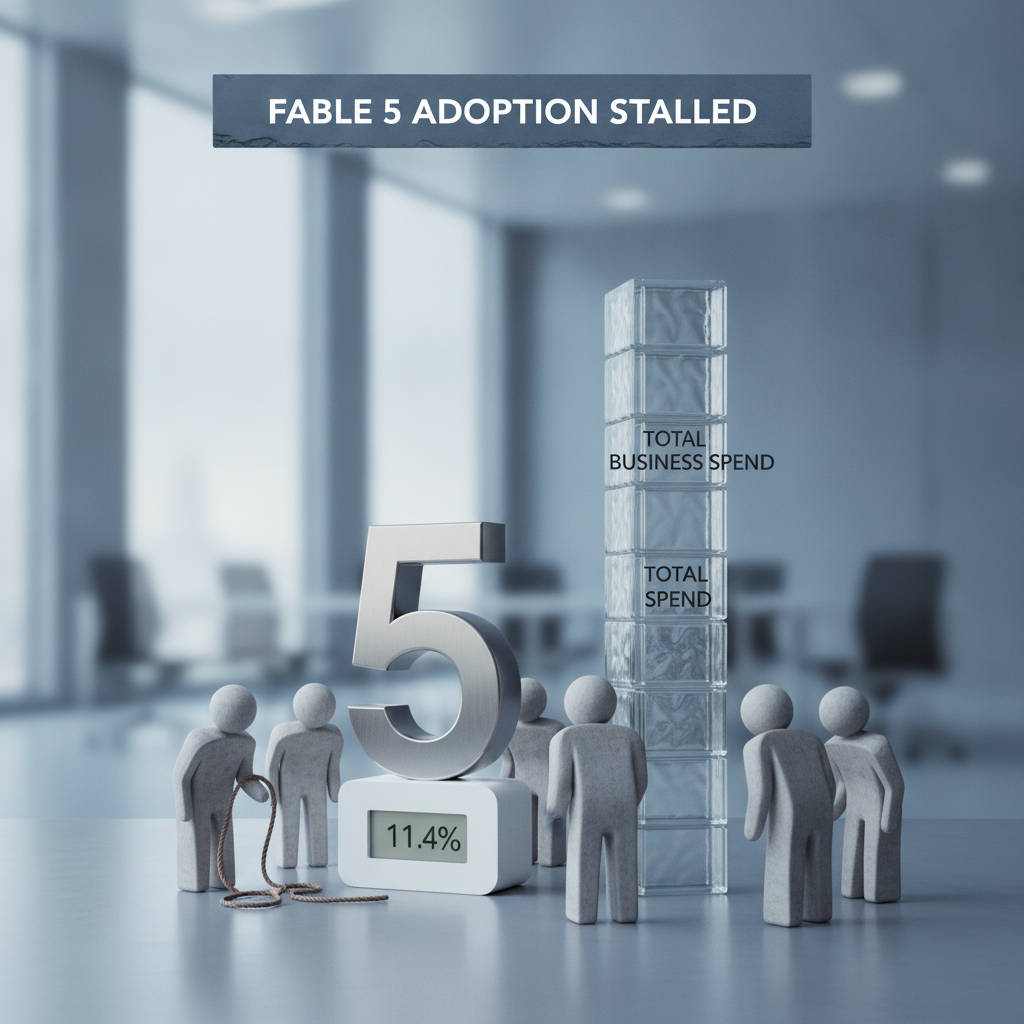
Anthropic's newest flagship model, Fable 5, accounted for an estimated 11.4% of dollars businesses spent on Anthropic models and roughly 6% of tokens purchased in its first month after launch, according to Ramp's AI Index tracking July 2026 usage — figures Ramp reported but that HarperFlow could not independently verify. The dataset appears to have been published in mid-August 2026 from Ramp's AI token spend management product and has been relayed by coverage including The Decoder and PYMNTS. At the core, Fable 5's token pricing at a premium tier well above the prior flagship collided with what Ramp described as a new upper bound on how much businesses will pay for incremental performance.
The Ramp data covers the month after Fable 5's interrupted rollout. Anthropic released Fable 5 publicly around June 9, halted access June 12 for a U.S. government review, and appears to have resumed global availability around July 1, so July is the first full month measured in Ramp's sample. In that month, Fable 5 reportedly generated on the order of 75% as much model-attributed spend as OpenAI's flagship GPT-5.6 Sol, which reportedly comprised around 25% of OpenAI tokens and about 23% of spend in the same period — again, figures relayed by Ramp that HarperFlow could not independently confirm. Ramp notes the token sample skews toward tech companies and is distinct from its broader AI Index base of more than 50,000 U.S. businesses.
Pricing helps explain the gap. Ramp characterizes Fable 5's pricing as roughly double the prior flagship's, and separate price sheets put Fable 5's list price well above Claude Opus 4.8's — on the order of double in both directions, input and output. That premium sets up the three structural blockers unpacked in the next sections: the price ceiling for routine work, the shift from flat subscriptions to mandatory usage-based billing that exposes that premium on every task, and the lack of Zero Data Retention support that removes regulated buyers from the eligible market.
That headline number raises an obvious question: what, specifically, is stopping businesses from buying it?
Fable 5's reported 11.4% share of Anthropic business spend against a roughly 6% share of Anthropic tokens in Ramp's measurement implies buyers paid something like 1.9x the blended average Anthropic token price for Fable 5, if both figures hold. That gap is a Ramp-reported pattern; what it implies about buying behavior is analyst inference, and the underlying percentages themselves have not been independently verified by HarperFlow.
The topline number is notable — now the data needs unpacking to see who's actually still paying for it. The Ramp AI Index reports that over the last month after launch, Fable 5 made up only a small share of tokens businesses purchased from Anthropic against a larger share of dollars spent. The Decoder's coverage relayed the same pair in its first-month framing.
Here is the arithmetic that matters, treating Ramp's reported figures at face value: if 6% of volume drives 11.4% of spend, Fable 5's average realized price per token works out to roughly 1.9x the average price of all Anthropic models businesses were buying in that window. Ramp itself describes Fable 5 as "their most expensive model by far," priced well above the comparison flagship.
Ramp sources this chart from its token spend management product that tracks daily token usage by firms, and notes its methodology caveat explicitly: the sample skews slightly more tech-y than the typical AI Index sample, so actual Fable adoption is likely even lower than estimated. For context, Ramp's data reportedly puts GPT-5.6 Sol at around a quarter of OpenAI tokens and just under a quarter of spend in the same period, with Fable 5 generating roughly three-quarters as much model-attributed spend as GPT-5.6 Sol — figures that, like the Anthropic-side numbers, come from Ramp's reporting rather than independent confirmation.
Cross-checking price explains the gap directionally. Anthropic's official pricing lists Claude Fable 5 well above the prior flagship tier, Claude Opus 5 and Claude Opus 4.8 — on the order of double on both input and output. That is broadly consistent with Ramp's characterization and would explain why spend share runs ahead of token share if buyers use any material amount of output tokens.
The pattern points to selective rationing rather than broad rollout. A low token share plus high dollar share suggests buyers reserve Fable 5 for high-value, low-volume tasks where frontier capability justifies the premium, while routing bulk, high-volume workloads to Sonnet, Haiku, or older Opus models. It is use-case triage, not outright rejection.
The spend/token gap suggests Fable 5 is being bought selectively for high-stakes tasks, not adopted broadly — a rationing pattern, not a rejection.
The pricing math explains part of the hesitation, but pricing alone doesn't explain why entire buyer segments are opting out completely.
Claude Fable 5 faces three distinct enterprise adoption blockers that affect buyers differently: a premium API pricing tier for input and output tokens, a shift to usage-credit billing that appears to have taken effect after July 7, 2026, and a mandatory data retention window said to run around 30 days that precludes Zero Data Retention agreements.
Pricing explains some hesitation, but the full picture requires separating which blocker hits which type of buyer.
| Buyer Segment | Price Sensitivity | Billing Model Fit | Data-Retention Requirement | Primary Blocker |
|---|---|---|---|---|
| Individual developers / power users (agentic coding) | High — output-token heavy workflows amplify cost | Poor — variable multi-day runs are hard to budget under usage billing | Low — rarely handles regulated data | Output token pricing |
| Mid-market SMBs / IT buyers | Medium — care about predictable monthly cost | Poor — usage-credit billing breaks flat-budget procurement norms | Low to medium | Billing model shift |
| Healthcare, finance, government contractors | Low to medium — capability can justify cost if terms allow | Medium — variable billing is workable if contract terms are met | Critical — ZDR or equivalent is a compliance prerequisite | No Zero Data Retention option |
| Enterprise platform / engineering teams (agentic, high-context work) | Low for high-stakes runs, high for bulk workloads | Medium — can absorb variability for exception-list use cases | Medium — depends on data sensitivity of workload | Combination of price ceiling and ZDR gap |
Anthropic's pricing for Fable 5 sits at a premium tier for both input and output tokens, with a large discount for prompt caching — pricing has been widely reported, though the exact per-token figures should be checked against the official page rather than treated as fixed. The listing positions Fable 5 above Anthropic's prior Opus-class flagship, which coverage consistently describes as roughly half the output cost, making Fable 5 the most expensive Claude model to run for long outputs. For individual developers and power users doing multi-day autonomous coding sessions, the output rate is the decisive variable because output tokens dominate agent harnesses that test and rewrite their own code.
Anecdotal discussion on r/ClaudeAI reflects that developer sentiment (practitioners flag cost per long run as the reason to fall back to Opus models) but that should be read as anecdotal, not statistical.
The second blocker is billing model fit. Sometime after July 7, 2026, Claude Fable 5 appears to have shifted to usage-credit billing, according to SaaSRise's reporting of Anthropic's enterprise update. The same update reportedly adds spend-threshold alerts and an Analytics API, but removes the model from predictable flat subscription buckets until capacity allows a return.
For mid-market SMBs and IT buyers managing monthly budgets, this breaks procurement norms. Variable token burn for deep research and agent workflows makes forecasting hard, and spend alerts do not restore a fixed per-seat cost. Even if per-token prices fell, the unpredictability concern remains unless Anthropic restores subscription-inclusive access.
The third blocker is contractual, not economic. Anthropic's product page notes that using Fable requires a data retention window, reported at around 30 days, for safety monitoring. That directly prevents Zero Data Retention (ZDR) agreements that regulated buyers require — a distinction that, per available reporting, sets Fable 5 apart from other current Claude models, which can reportedly operate under ZDR.
For healthcare, finance, and government contractors, ZDR, or at minimum no-training and immediate deletion guarantees, is a compliance prerequisite for handling PHI, customer financial data, or CUI. If the model retains prompts for weeks rather than zero days, legal and security teams cannot approve it regardless of capability or price. Unlike pricing, this cannot be solved with discounts or credits; it requires a separate contractual pathway or a different model version.
Segment-by-segment, the pattern is consistent — but it only matters commercially if competitors are capturing the budget Fable 5 is losing.
Claude Fable 5 is Anthropic's first flagship priced at a premium tier for both input and output tokens, roughly double the rate of Anthropic's immediately prior flagship, Opus 5 and Opus 4.8, on the same official pricing table.
Once it's clear who's holding back and why, the next question is where that spend is actually landing instead. Inside Anthropic's own lineup, the budget has a closer, cheaper place to stay. The official pricing table lists Claude Opus 5, Opus 4.8, Opus 4.7 and Opus 4.6 at a shared price point well below Fable 5, with cache hits and Batch API rates discounted further. Fable 5's list price represents roughly a 2x step-up for every token class, even before extended thinking tokens that bill as output. Sonnet 5 and Sonnet 4.6 remain the production default for most workloads because they keep the 1M context window at a fraction of Fable's input price.
Against rival frontier labs, the gap is directionally the same. A third-party pricing comparison that aggregates current vendor rates puts GPT-4o's list price at a fraction of Fable 5's input and output cost — figures worth checking against OpenAI's own pricing page rather than treating as exact. OpenAI and Google both publish their flagship tiers on official pricing pages under pay-as-you-go, usage-based billing — the same model Anthropic uses for the API: no monthly seat fee for the API, metered per request, with optional Batch discounts. Fable 5 does not introduce a new flat subscription for API use; it continues usage-based billing, but at the higher tier, with the existing prompt-cache discount on cached input still applying.
The terms difference matters more than the price multiple for regulated buyers. Anthropic's own Fable 5 product page states that using Fable requires a multi-week data retention window for safety monitoring. Prior Opus 4.x and Sonnet tiers, and competing enterprise tiers, are offered with Zero Data Retention or equivalent data-handling options for eligible contracts, while Fable 5 is explicitly excluded from ZDR at launch. The same pricing page reportedly adds a modest multiplier for US-only inference on Claude 4.6 and later models, which would stack on Fable's already-premium base if accurate. That combination — a step up from the prior flagship on input and output, no ZDR path, and a possible extra residency surcharge for data-bound workloads — is where Ramp's spend data finds a home: budgets staying on Opus 5 / Opus 4.8, Sonnet 4.6 / Sonnet 5, and rival flagships that meet existing procurement and privacy terms without a price ceiling break.
Fable 5 adoption will recover only if Anthropic changes commercial terms, not model quality. The model tops capability benchmarks yet remains a small slice of business spend because price and data-retention terms block broad enterprise rollout.
With the pricing landscape and buyer blockers both mapped, the remaining question is what actually needs to change for adoption to move.
Three conditions would materially shift usage:
Zero Data Retention returns for Mythos-class models. Today Fable 5 cannot run under existing ZDR agreements, and prompts are reportedly retained for a period around 30 days for trust and safety purposes on every platform where the model is offered. Until Anthropic restores ZDR eligibility, regulated workloads in finance, healthcare, legal, and any environment with source code or customer PII under strict confidentiality will stay off the model, regardless of performance. Enterprise platform teams will keep it on an exception list, not a default router.
Pricing flexibility improves for high-volume use. That could be a lower-cost batch lane, stronger prompt-caching economics for 1M-context jobs, or a committed-use tier that caps effective cost. Pure usage-based billing without a predictable flat option makes forecasting hard for teams running classification, extraction, or support automation at scale. Without such a lane, those workloads continue to default to lower-priced Claude tiers.
Workload mix evolves toward agentic, high-context work. Fable-class reasoning pays off when one high-stakes run replaces multiple failed loops, human review cycles, or custom tooling. As more budget moves from simple chat and summarization to autonomous coding, multi-step research, and large-context decision support, the premium becomes easier to justify.
Practical guidance for buyers evaluating now:
Adopt Fable 5 if you have low-volume, high-consequence work: complex refactoring across large repositories, safety-critical analysis, or frontier research where a better first-pass answer saves hours of engineering time. Isolate its traffic, scrub secrets before sending, and require human approval on outputs.
Hold off if you handle high-volume, cost-sensitive work, need ZDR guarantees, or route through Bedrock, Google Cloud, or Microsoft Foundry under existing ZDR contracts. For those cases the current retention policy creates contractual and compliance risk that outweighs benchmark gains. Use Opus or Sonnet class for production and re-evaluate only if Anthropic publishes updated retention terms. No public roadmap currently confirms such an update, so any expected change should be treated as speculative until Anthropic documents it.
Teams deciding today should run a side-by-side cost-to-completion test on a representative job, not just token price, and track review hours saved versus total tokens consumed.
Fable 5's adoption ceiling isn't a quality problem. It's a pricing-and-terms mismatch that only shifts if Anthropic changes the terms, not just the model.
The reported 11.4% share of spend against roughly 6% share of tokens implies selective rationing, not broad rollout. Buyers appear to reserve Fable 5 for low-volume, high-value tasks while routing bulk work to Sonnet or older Opus models.
The official pricing table lists Claude Fable 5 at $10 / MTok input and $50 / MTok output, while Claude Opus 5 is $5 / MTok input and $25 / MTok output. That is roughly double on both sides, and output dominates cost in agent harnesses that rewrite and test their own code.
No for API use. After July 7, Fable 5 shifted to usage-credit billing and was removed from flat subscription buckets until capacity allows a return. Anthropic added spend-threshold alerts and an Analytics API, but billing remains variable per request.
Zero Data Retention requires zero days of prompt retention and no training. Anthropic's product page says using Fable 5 requires a retention window reported around 30 days for safety monitoring. Legal teams handling PHI, financial data or CUI cannot approve that window, regardless of price.
The Ramp AI Index methodology note says the token sample skews slightly more tech-y than the typical AI Index sample. Ramp tracks daily token usage via its token spend management product, and its broader base is more than 50,000 U.S. businesses, so the wider market likely adopts even less.
Caching helps a lot for repeated large context, with cache hits discounted further on the official table, but output tokens still bill at the premium tier. For classification, extraction or support automation where output volume is high, the effective cost stays well above Sonnet 5 or Opus 5.
Inside Anthropic, budget stays on Opus 5, Opus 4.8, Sonnet 4.6 and Sonnet 5, which share a lower price point on the official pricing table. Outside, Ramp reported GPT-5.6 Sol at around 25% of OpenAI tokens and about 23% of spend in the same period.
No. The requirement is tied to the model, not the channel. Anthropic's Fable 5 page states use requires a multi-week retention window on every platform where offered, unlike prior Opus and Sonnet tiers that can operate under ZDR for eligible contracts.